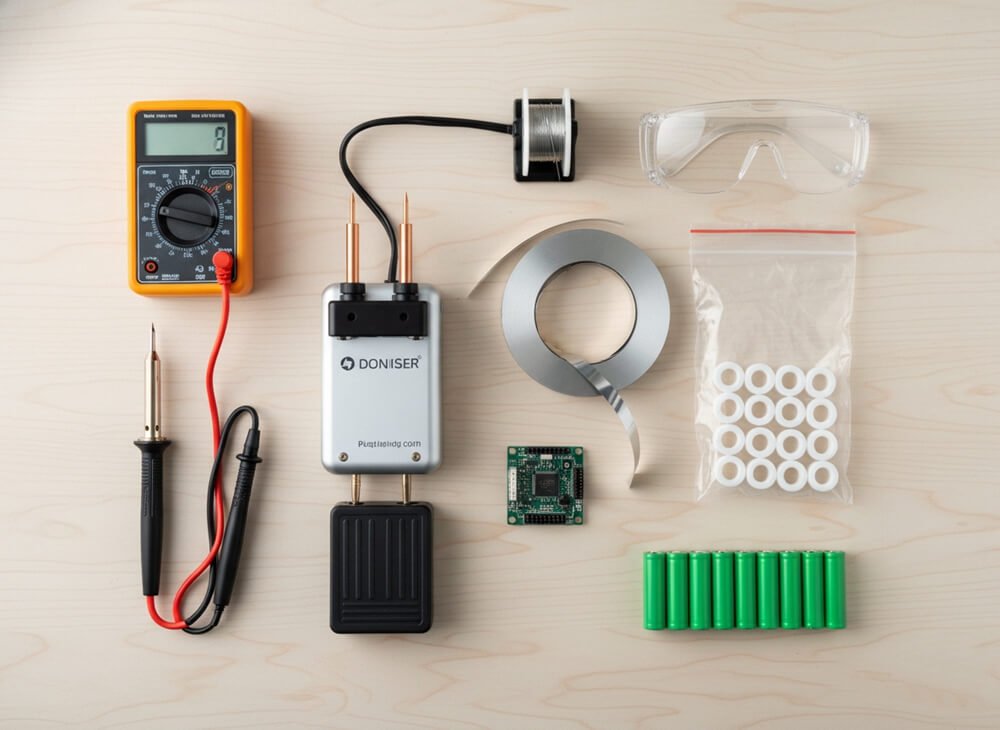
What Exactly Is a Nickel Strip in Battery Packs?
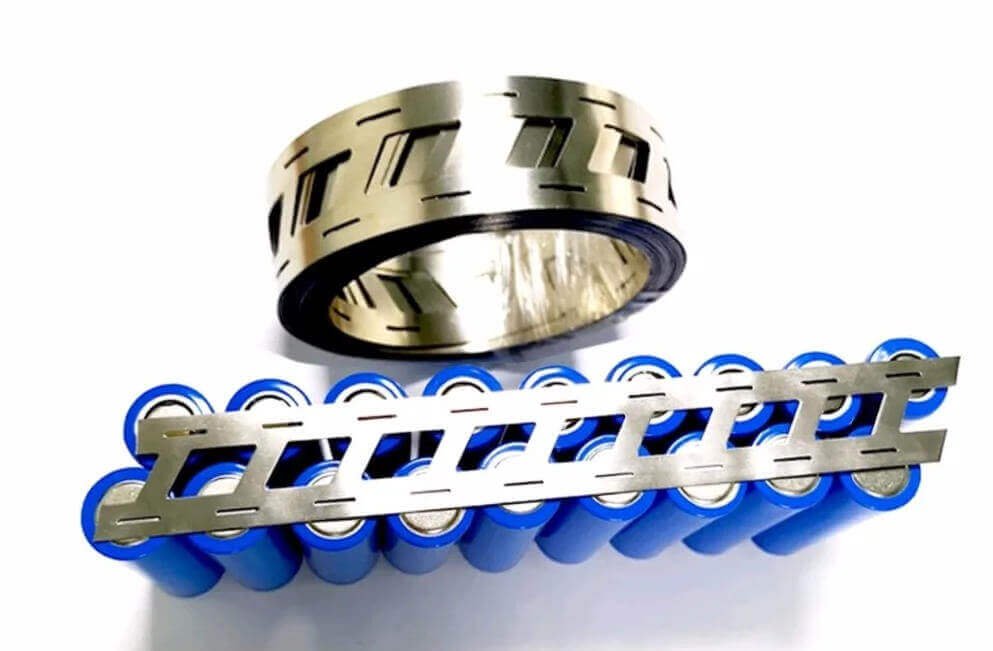
Definition and Core Function
At its simplest level, a nickel strip is a thin, conductive metal tape used to connect battery cells in series or parallel configurations. It is the “electrical highway” of a battery pack. Without it, the energy stored in your 18650 or 21700 cells would have nowhere to go.
For battery integrators and DIY enthusiasts, the nickel strip serves three critical roles:
- Current Transmission: It carries the electrical load from one cell to the next with minimal resistance.
- Structural Integrity: It physically holds the pack together, fixing the cells in their specific arrangement.
- Thermal Management: It helps manage heat distribution during the charge and discharge cycles.
According to industry research, nickel is one of the most reliable interconnect materials available. It isn’t just a piece of metal; it is a carefully engineered component designed to ensure efficient current flow and strong weldability.
The Chemical Composition
When we talk about “pure nickel,” we aren’t just using a marketing buzzword. We are referring to a specific metallurgical composition. To be classified as pure nickel suitable for battery packs, the material typically needs to be 99.5% pure or higher.
There are premium grades, such as Nickel 270, which boast purity levels as high as 99.98%. However, the industry standard workhorse is often Nickel 200 or 201. These grades are commercially pure (usually 99.6% and higher) and are engineered to have very low levels of impurities like carbon or sulfur, which can hinder conductivity.
Below is a breakdown of the typical chemical elements found in high-quality Nickel 200/201 strips. Notice how dominant the nickel content is compared to other trace elements.
| Chemical Composition of Nickel 200/201 (Standard Grade) | |
|---|---|
| Element | Percentage (%) |
| Nickel (Ni) | 99.6 (Min) |
| Manganese (Mn) | 0.25 |
| Iron (Fe) | 0.07 |
| Silicon (Si) | 0.14 |
| Carbon (C) | 0.01 |
| Copper (Cu) | 0.001 |
| Sulfur (S) | 0.001 |
High purity is the single most important factor determining electrical performance. Impurities act as obstacles to electricity, increasing resistance and generating heat—two things you definitely want to avoid in a battery pack.
Why Are Nickel Strips Used for Battery Packs?
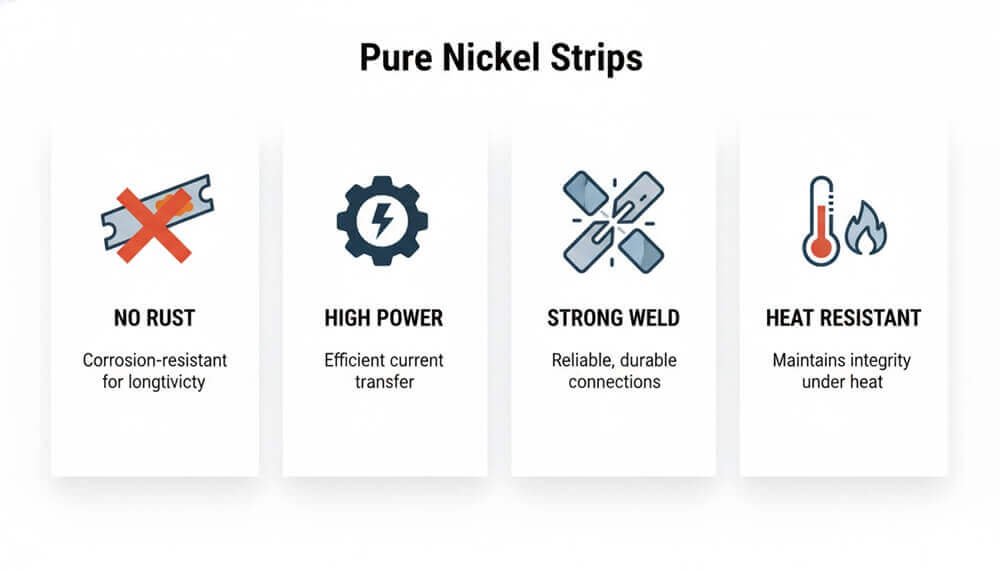
You might be wondering, “Why not use copper? It conducts electricity better.” Or “Why not use steel? It’s cheaper.” While those points are true, nickel offers a unique “Goldilocks” combination of properties that makes it the undisputed king of battery assembly. Here are the key reasons why manufacturers prefer it.
1. Electrical Conductivity and Low Resistance
While nickel isn’t as conductive as copper, pure nickel is significantly more conductive than steel. High-purity nickel strips offer very low electrical resistivity, typically around 6.9 µΩ·cm. In contrast, stainless steel ribbon can have a resistivity greater than 70 µΩ·cm—that is over ten times the resistance!
This low resistance prevents voltage drops. When resistance is high, you lose power before it even leaves the battery pack. Pure nickel ensures that the energy flows efficiently from the battery to your device, whether it’s an e-bike motor or a medical ventilator.
2. Unmatched Corrosion Resistance
One of nickel’s superpowers is that it doesn’t easily oxidize or corrode. Unlike steel, which rusts, or copper, which turns green with oxidation, nickel remains stable even in humid environments or when exposed to electrolyte vapors.
This is crucial for longevity. If a battery connection corrodes, resistance increases, heat builds up, and the connection eventually fails. Nickel’s natural resistance to caustic solutions and atmospheric corrosion ensures that the electrical path remains clear for the entire life of the battery pack.
3. Superior Weldability
This is perhaps the most practical reason for integrators. Pure nickel strips are a dream to spot weld. The material spot welds cleanly to battery terminals without requiring excessive heat that could damage the sensitive internal chemistry of the cell. It provides a consistent, strong bond that can withstand the vibrations of a moving vehicle without cracking.
4. Thermal Stability and Safety
Batteries get hot. During heavy use or rapid charging, temperatures rise. Nickel has a high melting point of approximately 1455°C. It maintains its structural integrity even under high thermal stress. This stability reduces the risk of thermal runaway, a dangerous condition where overheating leads to fire.
5. Mechanical Strength
Nickel is tough. It has good tensile strength (up to 130 N/mm²) and excellent ductility. This means it can handle the physical stresses of assembly and the vibrations of daily use without deforming or breaking. It holds the pack together physically, acting as a structural component as well as an electrical one.
Types of Nickel Strips: Pure Nickel vs. Nickel-Plated Steel
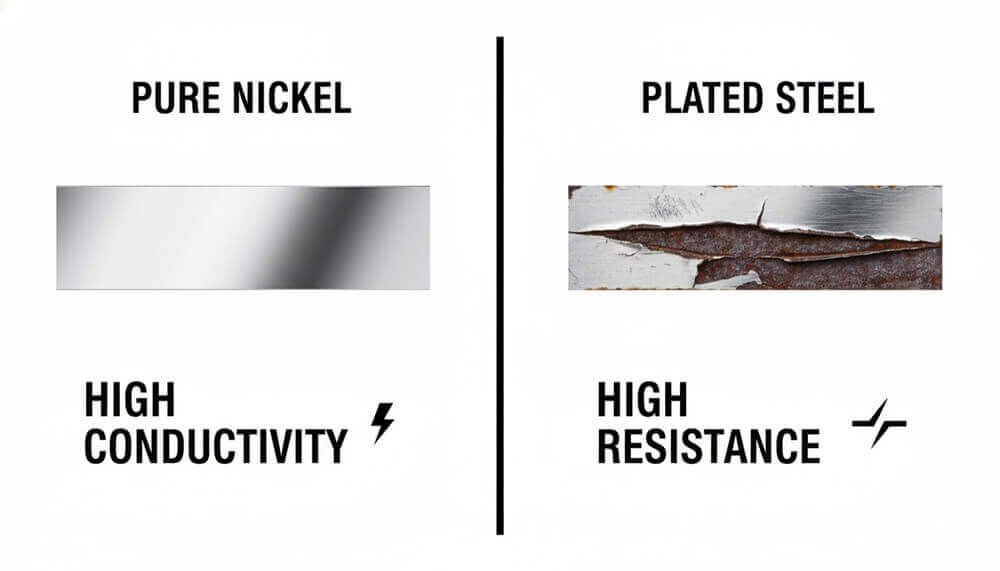
What is Pure Nickel Strip?
Pure Nickel (often Grade 200 or 201) is solid nickel through and through. It is the premium choice for high-drain applications like electric vehicles (EVs) and power tools. Because it is solid nickel, it has excellent conductivity and corrosion resistance throughout the entire thickness of the strip.
- Pros: High conductivity, excellent corrosion resistance, easy to weld, low resistance.
- Cons: Higher cost compared to plated steel.
- Best For: EVs, e-bikes, drones, medical devices, and any high-current application.
What is Nickel-Plated Steel Strip?
Nickel-Plated Steel is essentially a strip of regular steel that has been coated with a very thin layer of nickel. It looks identical to pure nickel on the outside, but inside, it is just steel.
While it is cheaper, steel has much higher electrical resistance. Using plated steel in a high-power battery pack can lead to significant heat generation. Furthermore, if the thin nickel plating is scratched or damaged during assembly, the steel core underneath will rust rapidly, leading to connection failure.
- Pros: Lower cost, higher tensile strength.
- Cons: High resistance (heating issues), poor corrosion resistance if scratched, harder to weld reliably.
- Best For: Low-cost, low-drain consumer electronics (like small toys) where high current isn’t needed.
Let’s look at the data to compare these two materials side-by-side.
| Pure Nickel vs. Plated Steel Comparison | ||
|---|---|---|
| Property | Pure Nickel Strip | Nickel-Plated Steel Strip |
| Conductivity | High (Low Resistance) | Medium-Low (High Resistance) |
| Resistivity | ~6.9 µΩ·cm | ~1.7 µΩ·cm (Copper core) / >70 µΩ·cm (Steel) |
| Corrosion Resistance | Excellent (Inherently rust-proof) | Poor (Rsts if plating is breached) |
| Weldability | Strong, Consistent (9.7/10 Score) | Less Reliable, Brittle (3.8/10 Score) |
| Typical Application | EVs, High-Drain Tools | Low-cost Consumer Packs |
How to Identify Real vs. Fake Nickel Strips

One of the biggest scams in the battery building world is selling plated steel strips as “pure nickel.” They look identical, and since nickel is magnetic, you cannot use a magnet to tell them apart. Both will stick to a magnet!
However, you don’t have to be a victim. There are two definitive ways to test your strips at home.
Method 1: The Spark Test (The Dremel Method)
This is the fastest way to know the truth. You will need a rotary tool (like a Dremel) with a grinding wheel.
- Take a sample piece of your strip.
- Touch the spinning grinding wheel to the strip.
- Watch the sparks.
The Result: If you see a shower of bright, flying sparks, it is STEEL. Steel sparks easily when ground. If you see very few or no sparks at all, it is PURE NICKEL. Nickel is much harder to spark.
Method 2: The Saltwater Corrosion Test
If you don’t have power tools, simple kitchen chemistry works too.
- Scuff up the surface of the strip with sandpaper or a house key. You want to scratch through any potential plating.
- Submerge the strip in a cup of salty water.
- Wait for 24 hours.
The Result: If you see rust forming on the scratched areas, it is STEEL. The saltwater accelerated the corrosion of the exposed steel core. If the strip remains shiny and clean, it is PURE NICKEL.
Technical Specifications: Dimensions and Current Capacity
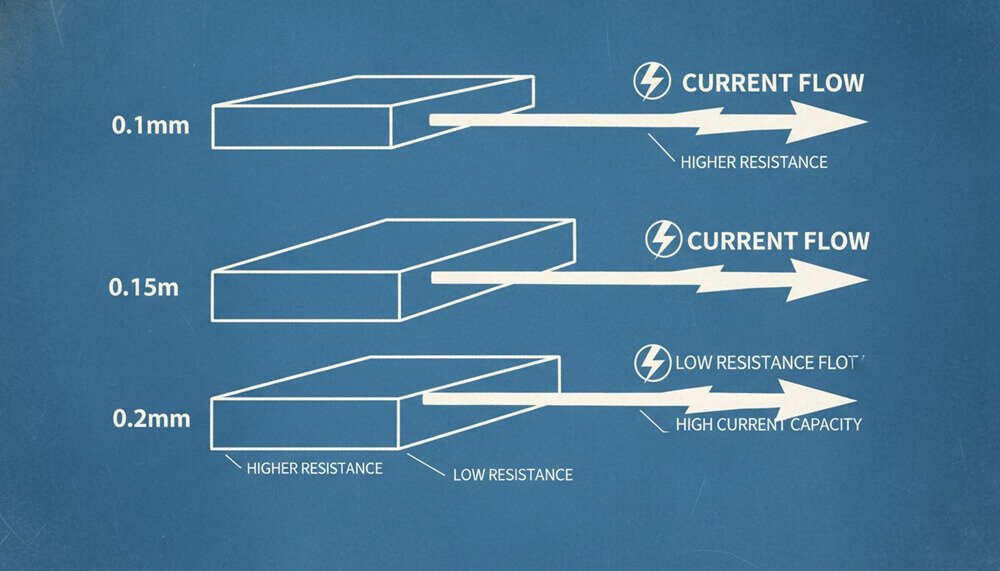
Choosing the right material is step one. Choosing the right size is step two. Nickel strips come in various thicknesses and widths, and picking the wrong one is like trying to drink a milkshake through a coffee stirrer—it just won’t work well.
Selecting the Right Thickness and Width
The thickness of the strip determines how much current it can handle without overheating. The most common thicknesses for 18650 battery packs are 0.1mm, 0.15mm, and 0.2mm.
- 0.1mm: Very thin and easy to weld, but only suitable for low-power applications (under 5 Amps).
- 0.15mm: The industry “sweet spot.” It balances flexibility with current capacity (good for 15-30 Amps). It is robust enough for e-bikes and power tools.
- 0.2mm: Used for high-drain applications. It carries more current but is stiffer and harder to weld, requiring a more powerful spot welder.
Current Carrying Capacity
You cannot guess here. If your motor pulls 30 Amps and your nickel strip can only handle 10 Amps, the strip will act like a fuse and melt, potentially destroying your battery. The rule of thumb is that every additional Amp demands a proportional increase in the cross-sectional area of the strip.
Here is a reference table to help you match your strip to your project needs:
| Nickel Strip Current Capacity Guide (18650 Packs) | |||
|---|---|---|---|
| Thickness (mm) | Recommended Max Current (Continuous) | Flexibility Rating | Best Use Case |
| 0.10 | ~5 – 7 Amps | High | Flashlights, Small Drones |
| 0.15 | ~15 – 20 Amps | Moderate | E-bikes, Power Tools, Scooters |
| 0.20 | ~25 – 30 Amps | Low | EV Conversions, High-Performance RC |
| 0.30 | ~40+ Amps | Very Low | Industrial Banks, Solar Storage |
Note: If you need to carry higher currents than a single strip allows, you can stack strips (weld one on top of another) or use wider strips to increase the cross-sectional area.
The Welding Process: How Nickel Strips Connect
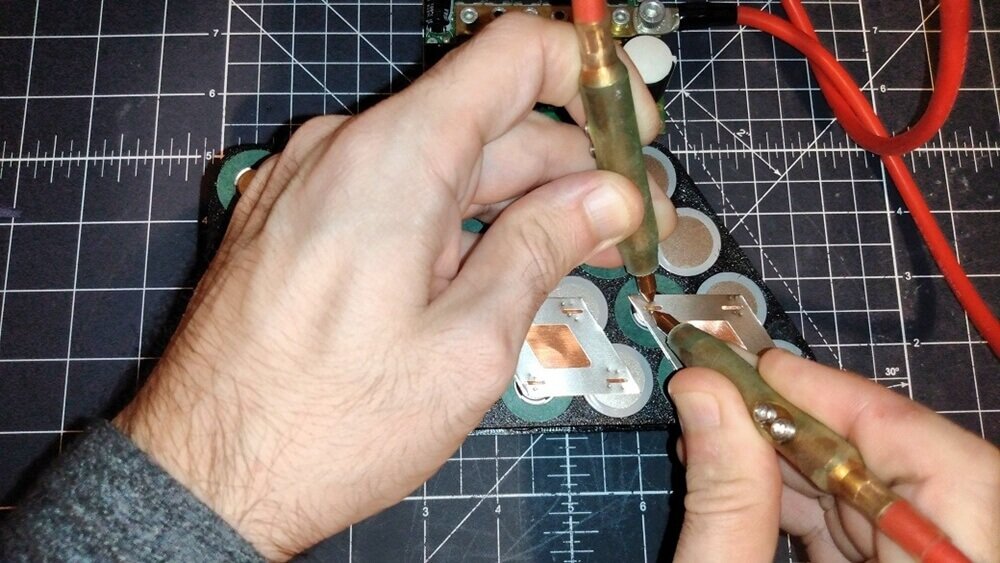
You have the right pure nickel strip in the correct size. Now, how do you attach it? The answer is Spot Welding.
Why Not Solder?
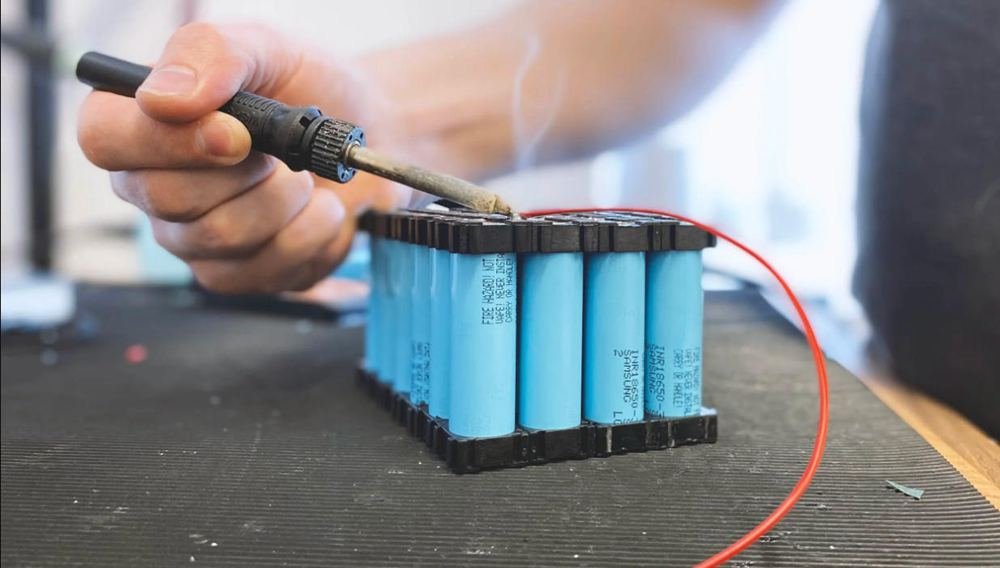
Soldering directly to battery terminals is generally discouraged. Soldering requires applying heat for several seconds to melt the solder. This heat transfers directly into the battery cell, which can degrade the internal seals and chemistry, reducing the battery’s life or causing safety issues.
Spot Welding Fundamentals
Spot welding uses a high-current pulse to create a tiny, localized melt pool that fuses the nickel strip to the battery terminal in milliseconds. Because the heat is so brief, the battery cell stays cool.
For a successful weld with 0.15mm pure nickel, your equipment needs to deliver a strong enough pulse—typically between 100 to 200 Amps per pulse depending on the duration settings. A weld that is too weak (“cold weld”) will pop off under vibration. A weld that is too strong can blow a hole right through the strip.
The “Pull Test” Quality Check
How do you know if your weld is good? Perform a destructive test on a scrap battery. Weld a strip to it, then grab the strip with pliers and rip it off.
A Good Weld: The metal strip tears, leaving pieces of nickel still attached to the battery terminal. This means the weld was stronger than the metal itself.
A Bad Weld: The strip pops off cleanly with no damage. This means the weld didn’t penetrate.
Applications: Where are Nickel Strips Used?
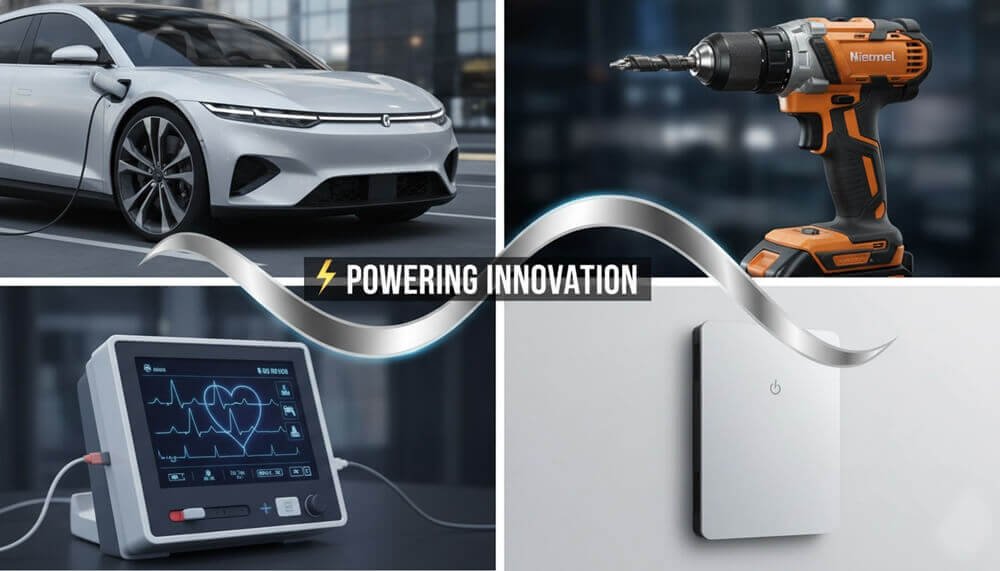
Nickel strips are the backbone of modern portable energy. Their reliability makes them essential across a wide range of industries.
- Electric Vehicles (EVs): The massive battery packs in EVs contain thousands of cells. Nickel strips are chosen for their ability to handle high currents and resist the constant vibrations of the road.
- Medical Devices: For portable ventilators, infusion pumps, and surgical tools, failure is not an option. Pure nickel is used here for its absolute reliability and corrosion resistance.
- Power Tools & Drones: These devices demand huge bursts of power (high discharge rates). Pure nickel’s low resistance ensures that power gets to the motor instantly without voltage sag.
- Energy Storage Systems (ESS): For solar backups and grid storage, batteries must last for years. Nickel’s resistance to environmental corrosion makes it the ideal choice for long-term infrastructure.
Advanced Topics: Repairs and Troubleshooting
Can You Reuse Old Nickel Strips?
It might be tempting to save money by reusing strips from an old battery pack, but the verdict is a hard NO. Metal fatigue, invisible micro-fractures, and work hardening occur when strips are ripped off old cells. Reusing these compromised strips can lead to high resistance and mechanical failure. Always use fresh, virgin material for new builds.
Repairing Damaged Connections
Sometimes a single strip in a pack might break or a weld might fail. You don’t always have to scrap the whole battery. You can carefully cut out the damaged section using fine snips (be careful not to short circuit anything!). Clean the terminal surface with isopropyl alcohol, and spot weld a new patch of nickel strip over the connection. Ensure the new strip overlaps the existing healthy metal by at least 3mm to ensure current continuity.
The Copper-Nickel Sandwich
For extreme performance enthusiasts, there is a technique called the “Copper-Nickel Sandwich.” Since copper conducts better but is hard to spot weld, builders place a strip of pure nickel on top of a copper strip. The welder hits the nickel, pushing heat through to the copper, fusing the sandwich to the battery. This gives you the conductivity of copper with the weldability of nickel—the best of both worlds!
People Also Ask (FAQs)
1. Is pure nickel strip really necessary, or can I use cheaper alternatives?
Yes, pure nickel is necessary for safety and performance in most lithium battery packs. Using cheaper plated steel increases resistance, which leads to heat buildup. In high-drain devices like e-bikes or scooters, this heat can damage cells or cause weld failures. It is an “expensive lesson” to learn when a cheap strip ruins a valuable battery pack.
2. How do I know if a nickel strip seller is trustworthy?
Trustworthy sellers often provide data sheets confirming the chemical composition (like ASTM standards). Look for sellers who explicitly state “99.9% Pure Nickel” and offer weight verification. Consistent positive feedback regarding the “saltwater test” or “spark test” from other buyers is also a good indicator.
3. Can I solder nickel strips instead of spot welding?
While physically possible, soldering is not recommended for attaching strips to battery cells. The prolonged heat required to melt solder can transfer into the battery cell, damaging the internal safety seals and chemistry. Spot welding is the industry standard because it is fast and keeps the cell cool.
4. Why does the thickness of the nickel strip matter?
Thickness determines the “pipe size” for your electricity. A strip that is too thin (like 0.1mm) cannot handle high currents (amps). If you push 30 amps through a strip meant for 5 amps, it will overheat and could act like a fuse, breaking the connection or causing a fire hazard.
5. Can I replace a single broken nickel strip without disassembling the whole battery?
Yes, it is possible. You can carefully cut out the broken segment, clean the terminals, and spot weld a new piece of pure nickel strip in its place. However, you must be extremely careful not to short-circuit the cells during the repair process.
Conclusion
The nickel strip may seem like a humble component, but it is the lifeline of your battery pack. Whether you are building a custom e-bike battery or repairing a power tool, the quality of your interconnects dictates the success of your project.
Remember the golden rules: Insist on verified pure nickel to ensure conductivity and safety. Choose the right thickness (0.15mm is often the sweet spot) to handle your current load. And always test your materials to avoid being scammed by plated steel imposters.
At the end of the day, a battery pack is only as strong as its weakest link. Don’t let that link be a cheap strip of metal. By choosing high-quality, pure nickel strips, you are investing in the longevity, safety, and performance of your device.
Ready to build a battery pack that lasts? Ensure your project is powered by the best materials in the industry.