What Are Nickel Strips and Why Do Dimensions Matter?
The Role of Nickel Strips in Lithium Battery Packs
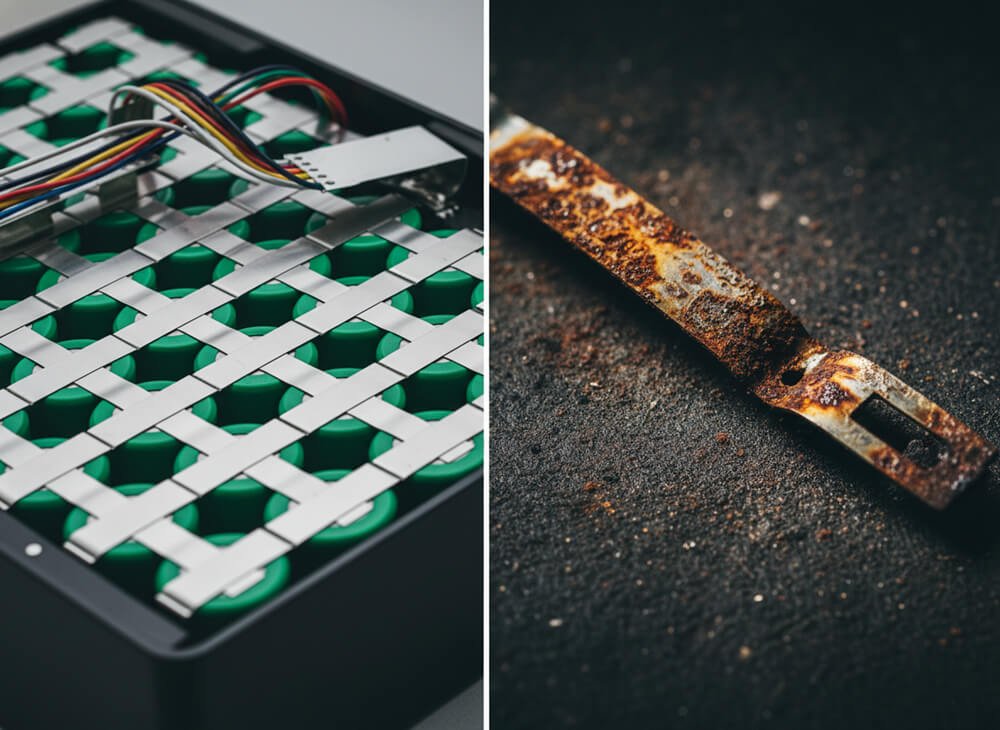
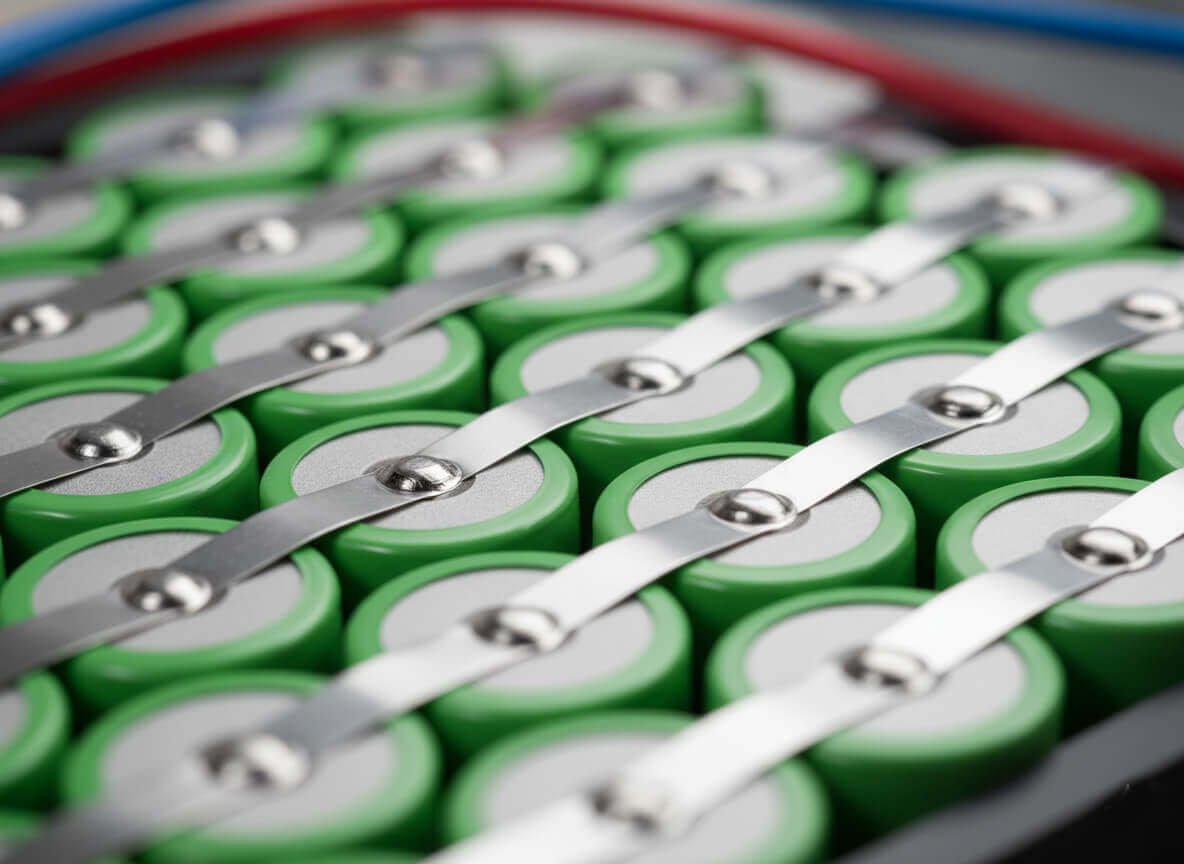
In the world of battery pack assembly, nickel strips act as the highway for electrical current. Their primary job is to connect individual cells—whether they are cylindrical 18650s, 21700s, or larger 32700s—in series and parallel configurations. This creates the conductive pathway that allows the battery pack to deliver consistent voltage and capacity.
Historically, nickel has been the go-to material for battery connections for decades. In the early 1980s, nickel-hydrogen batteries used in communication satellites relied on nickel components for energy storage. Later, in 1989, consumer-grade Nickel-Metal Hydride (NiMH) batteries utilized nickel strips for their durability. Today, in modern Lithium-ion packs, they serve critical functions beyond just conduction, including structural support and safety protection.
In advanced applications, such as the Tesla 4680 battery modules, these strips are laser-welded to stainless steel busbars to support massive discharge currents. They essentially ensure that energy flows efficiently from one cell to the next without interruption.
How Strip Size Impacts Safety and Performance
The dimensions of a nickel strip—specifically its width and thickness—determine its resistance. According to the laws of physics, any conductor with resistance will generate heat when current passes through it. The formula for this is I²R (Current squared times Resistance). This means that if you double the current, the heat generated quadruples.
If a strip is undersized (too thin or too narrow), it cannot handle the flow of electrons. This creates a “bottleneck” effect. The consequences of this are severe:
- Energy Loss: High resistance means power is converted into waste heat rather than moving your vehicle or powering your device. For e-bikes, this directly translates to reduced range.
- Thermal Runaway Risks: Excessive heat generated by the strip is transferred directly into the battery cell. Lithium-ion cells degrade rapidly when hot. In extreme cases, this heat can melt the strip or trigger a thermal runaway event, leading to fire or explosion.
- Component Damage: Heat can melt the insulation on wires or damage the sensitive electronics in your Battery Management System (BMS).
To ensure safety, the strip must be sized to handle the maximum continuous current of the system, not just the average draw. Proper sizing optimizes conductivity and keeps operating temperatures within a safe range.
Material Science: Pure Nickel vs. Nickel-Plated Steel
What is the Best Material for Battery Nickel Strips?
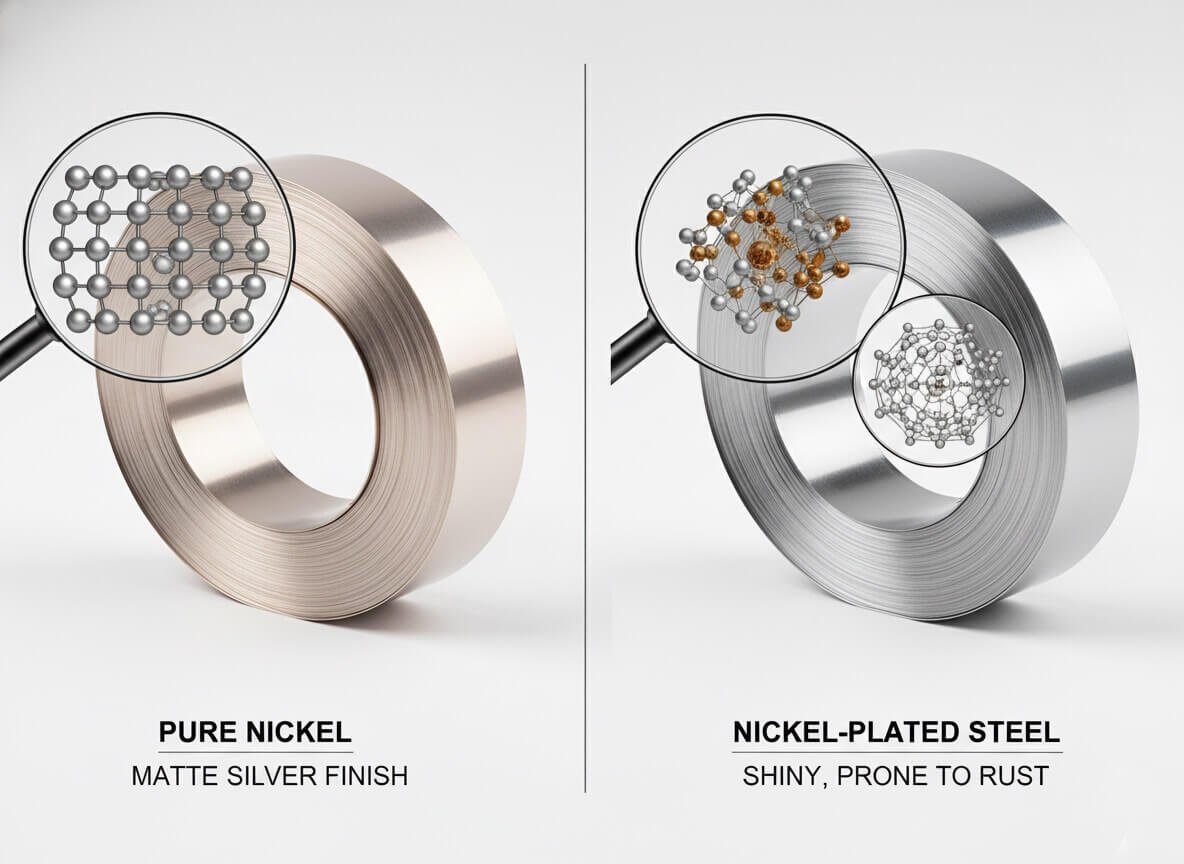
When shopping for battery connection strips, you will encounter two main materials. They look nearly identical to the naked eye, but their performance is vastly different.
1. Pure Nickel (Grade N6 / Ni200)
Pure nickel is the gold standard for battery building. It contains over 99.6% nickel content. Its primary advantage is low electrical resistance, making it an excellent conductor. It is also highly resistant to corrosion and oxidation, which is vital for the long-term health of a battery pack.
Best Use Cases: High-drain applications like e-bikes, power tools, medical devices, robotics, and industrial equipment where durability and efficiency are paramount.
2. Nickel-Plated Steel
This is simply a strip of steel that has been coated with a very thin layer of nickel. While it is stronger and cheaper than pure nickel, steel has significantly higher electrical resistance. In fact, steel is roughly 10 times more resistive than pure nickel. This means it generates much more heat for the same amount of current.
Best Use Cases: Low-cost consumer electronics, toys, or very low-current applications where heat generation is negligible.
How to Distinguish Between Pure Nickel and Plated Steel
Since you cannot tell the difference just by looking, you must perform a test before building your pack. Here are two reliable methods to verify your material.
The Spark Test
This is the quickest field test. You will need a rotary tool (like a Dremel) or a bench grinder.
- Take a sample piece of the strip.
- Touch it lightly against the grinding wheel.
- Observe the sparks:
- Pure Nickel: Will produce very few, short, dark-red sparks. It is hard to get it to spark at all.
- Steel: Will produce a shower of bright, branching yellow or white sparks, similar to a sparkler.
The Saltwater Test
If you don’t have a grinder, this chemical test is definitive.
- Aggressively scratch the surface of the strip with sandpaper or a file to expose the core metal.
- Submerge the strip in a cup of saltwater.
- Leave it for 24 hours.
- The Result: If rust forms on the scratched area, it is steel. Pure nickel will remain corrosion-free.
Always verify your materials. The extra effort ensures your battery pack is safe and performs as designed.
The Mathematics of Sizing: Current, Width, and Thickness

How Do I Calculate the Required Thickness of Nickel Strips?
To determine the right size strip, we need to look at resistance. The resistance of a metal strip is determined by its physical dimensions and the material’s inherent resistivity.
The formula is: Resistance = Length / (Width × Thickness) × Bulk Resistivity
Once you have the resistance, you can calculate the power loss (heat) using P = I²R.
For example, let’s look at a standard pure nickel strip with the following dimensions:
- Length: 50 mm
- Width: 14 mm
- Thickness: 0.15 mm
If this strip carries 40 Amps, the resistance is approximately 0.001664 ohms. The resulting voltage drop is a negligible 0.0666 V. This is within acceptable limits. However, if you used steel, the resistance would be much higher, leading to significant voltage drop and heat.
How to Calculate Current Demand for E-Bikes?
For e-bike builders, sizing starts with your motor and controller. You need to design for the continuous current draw, not just the peak.
The Formula: Continuous Current (A) = Motor Power (W) / Battery Voltage (V)
Here are some real-world examples:
| Motor Power | Battery Voltage | Calculated Current |
|---|---|---|
| 1000W | 48V | 20.8A |
| 750W | 52V | 14.4A |
| 500W | 48V | 10.4A |
Crucial Note: The BMS Factor. While the motor calculation gives you a baseline, your Battery Management System (BMS) is the ultimate gatekeeper. If your BMS is rated for 40A continuous discharge, your nickel strips must be sized to handle 40A safely. Always size for the “weakest link” in your safety chain.
How Many Amps Can a Nickel Strip Handle? (Ampacity Charts)
Calculating resistance for every build is tedious. Instead, builders rely on ampacity charts. These charts tell you the safe current limit for standard strip sizes based on acceptable heat rise.
Below is a simplified reference table for Pure Nickel strips. Note that these values are for optimal performance where the strip does not get significantly hot.
| Strip Size (Thickness x Width) | Optimal Current (A) | Acceptable Current (A) | Poor (Overheating Risk) |
|---|---|---|---|
| 0.1 mm × 5 mm | < 2.1 A | 3.0 A | > 4.2 A |
| 0.1 mm × 7 mm | < 3.0 A | 4.5 A | > 6.0 A |
| 0.15 mm × 7 mm | < 4.7 A | 7.0 A | > 9.4 A |
| 0.2 mm × 7 mm | < 6.4 A | 9.6 A | > 12.8 A |
| 0.15 mm × 8 mm | ~ 5.0 A | 7.5 A | > 10.0 A |
| 0.3 mm × 7 mm | < 10.0 A | 15.0 A | > 20.0 A |
The “Micah Toll” Rule of Thumb: For a quick estimation, many builders use the rule that a standard 0.15mm x 8mm pure nickel strip is good for about 5 Amps per strip. If your pack needs to deliver 20 Amps, you would need 4 of these strips sharing the load (20A / 5A = 4 strips).
Advanced Configuration and Series Connections
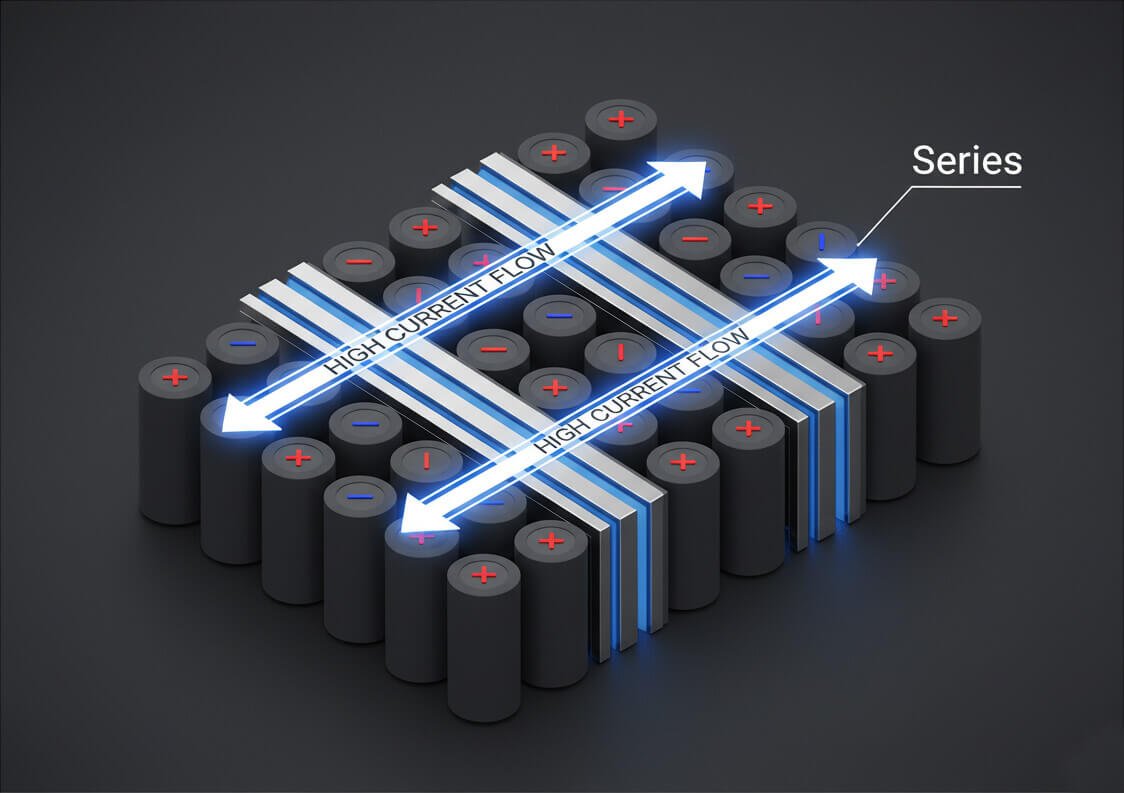
How Do I Arrange Nickel Strips for High-Current Battery Packs?
Designing a battery pack isn’t just about connecting dot A to dot B. The layout determines how current flows. In a battery pack, you have two types of connections:
- Parallel Connections: These connect the positive terminals to positives, and negatives to negatives. They balance voltage but split the current load. The current flowing here is relatively low.
- Series Connections: These connect the positive of one group to the negative of the next. This is the critical bridge where the full current of the entire pack flows.
The Pyramid Structure: When connecting long rows of parallel cells, current accumulates as it moves toward the series connection point. A common mistake is using a single strip across the entire parallel group. Instead, effective builders use a “pyramid” or “ladder” structure. You stack more layers of nickel near the bridge where the series connection happens, as this is where the current is highest. This distributes the load efficiently without wasting material on the low-current ends.
Can You Stack Nickel Strips for Higher Amperage?
Yes, absolutely. If a single 0.15mm strip can only handle 5 Amps, but you need to carry 10 Amps, you can spot weld a second strip directly on top of the first one. This effectively doubles the cross-sectional area and doubles the current carrying capacity.
Practical Example: Consider a builder creating a 6s5p pack using powerful Molicel P42A cells. This pack needs to deliver 85 Amps continuously. A single nickel strip would vaporize instantly. To handle this, the builder must layer multiple thick strips or use a more advanced technique.
The “Copper-Nickel Sandwich” Technique
For extreme currents (like 85A+), even thick pure nickel isn’t enough because nickel’s resistance is still higher than copper. Copper is roughly 4 times more conductive than nickel. However, copper is notoriously difficult to spot weld because it dissipates heat too quickly.
The solution is the “Copper-Nickel Sandwich.”
- The Core: A thick copper strip acts as the main highway for electricity.
- The Cap: A thin layer of nickel or steel is placed on top of the copper.
- The Weld: The spot welder heats the top nickel layer, which traps the heat long enough to fuse the copper stack to the battery terminal.
This advanced method combines the superior conductivity of copper with the weldability of nickel, allowing for massive power delivery in compact packs.
Case Studies and Real-World Applications
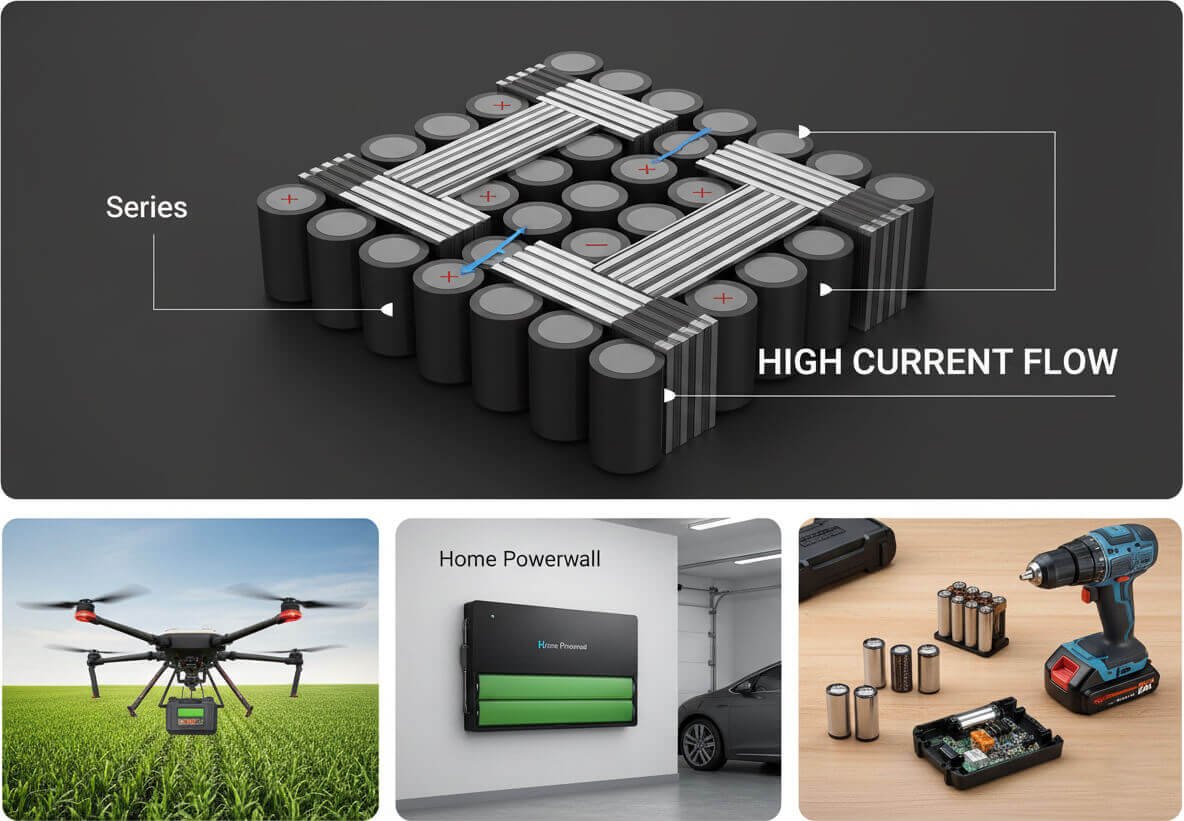
Case Study 1: Building a High-Current Agricultural Drone Battery
A forum user sought advice on building a 6s5p pack using high-power Molicel P42A cells. The goal was to sustain a massive 85 Amps continuous discharge with peaks up to 150 Amps for an agricultural spray drone.
The Challenge: Standard nickel strips (even pure ones) would overheat and fail under this load. The user asked if a 10mm wide strip was enough.
The Expert Consensus: Experienced builders immediately flagged this as a failure point. At 85A, nickel alone is insufficient. The community recommended the “Copper-Nickel Sandwich” technique.
The Debate: The user worried about copper corrosion in a wet agricultural environment. Experts countered that if moisture is entering the battery pack, the electronics and cells would fail long before copper corrosion became the primary issue. Sealing the pack is the priority; using the conductive copper sandwich is the only way to achieve the required performance.
Case Study 2: 48V LiFePO4 Powerwall with Large Cells
Another DIY builder was constructing a massive 48V home energy storage bank using large 32650 LiFePO4 cells. The sheer size of these cells required a unique approach.
The Challenge: Finding strips wide enough. Standard 8mm strips looked like thread on these giant cells. The builder needed 47.5mm wide custom strips.
Equipment Struggles: To weld thick 0.2mm or 0.3mm strips, the builder needed a powerful spot welder. They discovered that their home’s 120V electrical service required a 30A to 50A breaker upgrade just to power the welder without tripping the circuit.
The Solution: The builder shifted the design from a 16s6p layout to a 16s18p layout, mimicking professional “Battle Born” batteries, to better distribute the load across more parallel connections.
Case Study 3: Power Tool Battery Repair
A user was rebuilding a 5S3P power tool pack and needed it to handle 30 Amps continuously. The challenge was connecting the battery array to the BMS board.
The Challenge: The BMS connection points were small rectangular slots, designed for thin strips, not thick copper wires. There was no physical space inside the tight plastic housing for bulky wiring.
The Solution: The builder adopted a hybrid approach. They spot-welded nickel plates to the cells to avoid heat damage. Then, they soldered thick copper wire onto those nickel plates to carry the heavy current to the BMS, effectively bypassing the limitations of the BMS slot size.
Joining Techniques: Welding vs. Soldering
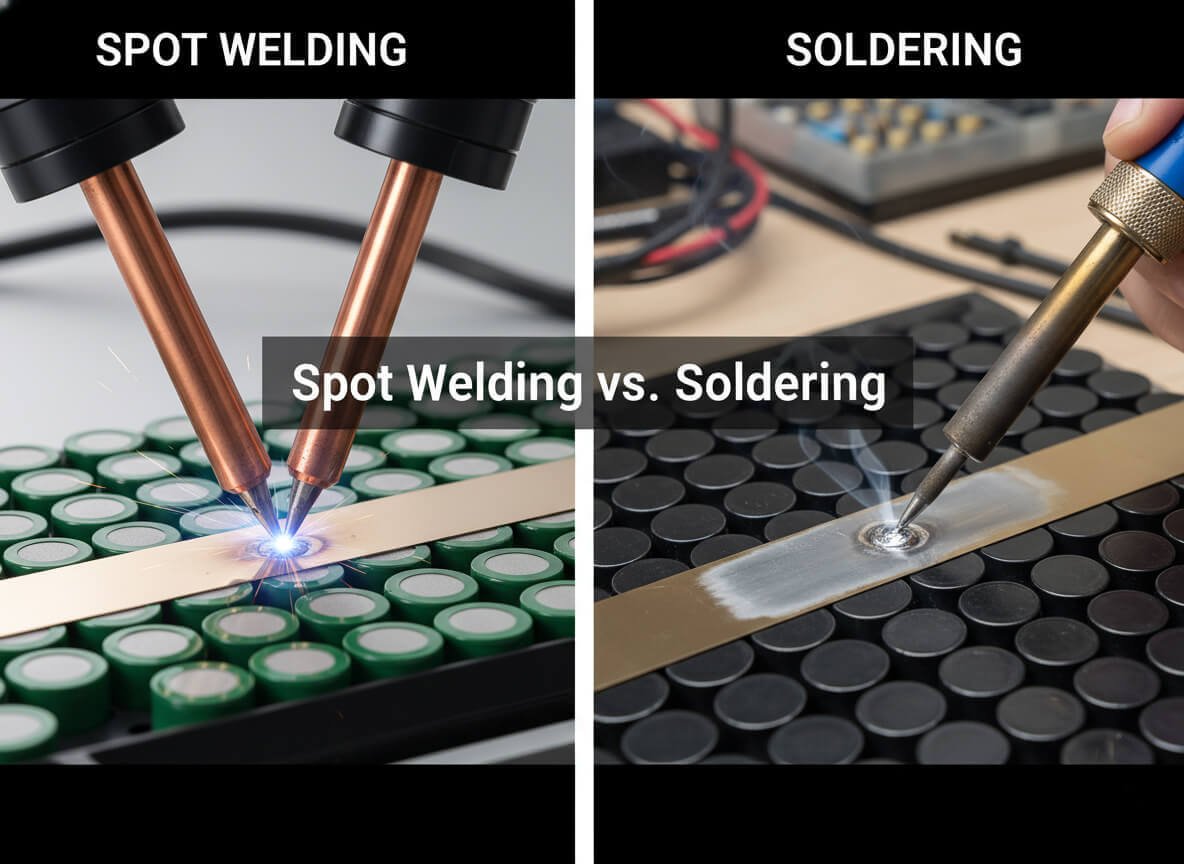
Is Spot Welding Better Than Soldering for Batteries?
When attaching strips to cells, you have two main options. For Lithium-ion batteries, there is a clear winner.
Spot Welding
This is the industry standard. It uses a high-current pulse to fuse the metals together instantly.
- Pros: Extremely fast and consistent. Crucially, it generates minimal heat, keeping the battery cell cool and safe.
- Cons: Requires specialized equipment (a spot welder) which can be expensive. It also struggles to weld highly conductive metals like pure copper without special techniques.
Soldering
This involves melting filler metal to join the strip.
- Pros: Flexible and cheap. Everyone has a soldering iron.
- Cons: High Risk. To get solder to stick to a battery terminal, you must apply significant heat. This heat transfers directly into the cell, damaging the internal chemistry. Studies suggest heat from soldering can permanently degrade a cell’s capacity by up to 10% instantly.
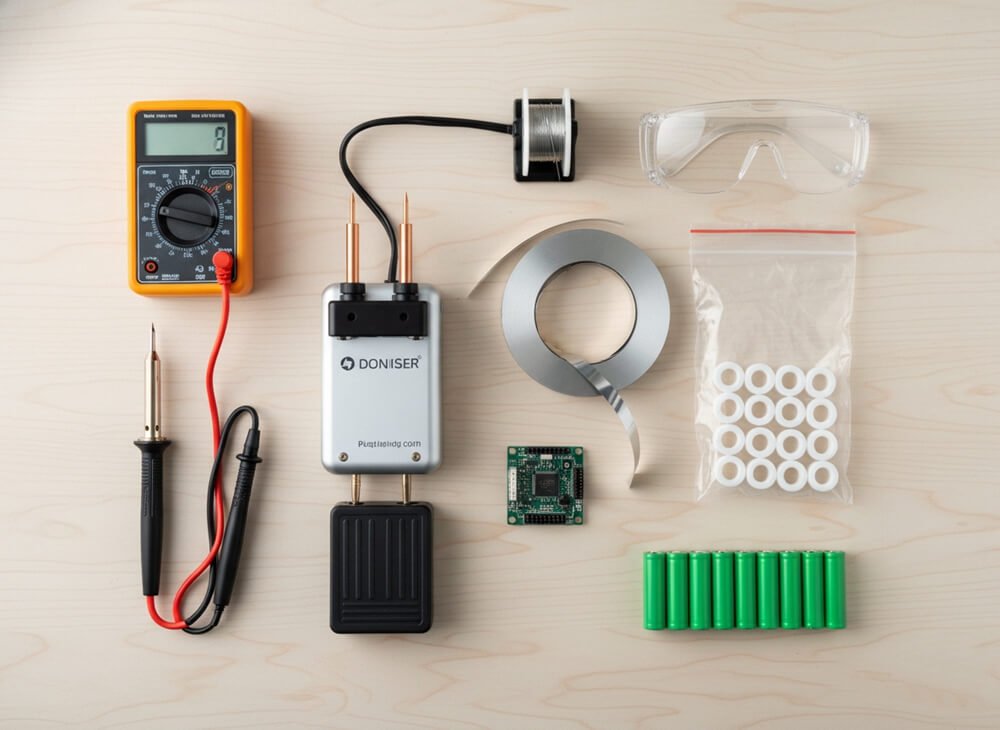
The Verdict: Always spot weld directly to the cell. If you must use solder (e.g., to attach a BMS wire), use the “Hybrid Approach”: Spot weld a nickel strip to the cell first, then solder your wire to the nickel strip at a point between the cells. The strip acts as a heat sink, protecting the battery.
Selecting a Spot Welder and Electrodes
Not all welders are created equal. For thin 0.1mm strips, a cheap portable welder might work. But for 0.2mm pure nickel or copper sandwiches, you need power.
- Equipment: Users discuss models like the “Kweld” (battery-powered, very high current) and the “Glitter 811H” (capacitor-based). For mains-powered units like “Sunkko,” ensure your home’s circuit breaker can handle the surge (often requiring 30A+ breakers).
- Electrodes: The tips of your welding pen matter.
- Copper Electrodes: These tend to stick to the nickel strip, frustrating the user and slowing down work.
- Tungsten Alloy Electrodes: These are preferred for high-power welding. They don’t stick and handle the heat much better, though they are more brittle.
Technical Requirements for NEV (New Energy Vehicle) Batteries
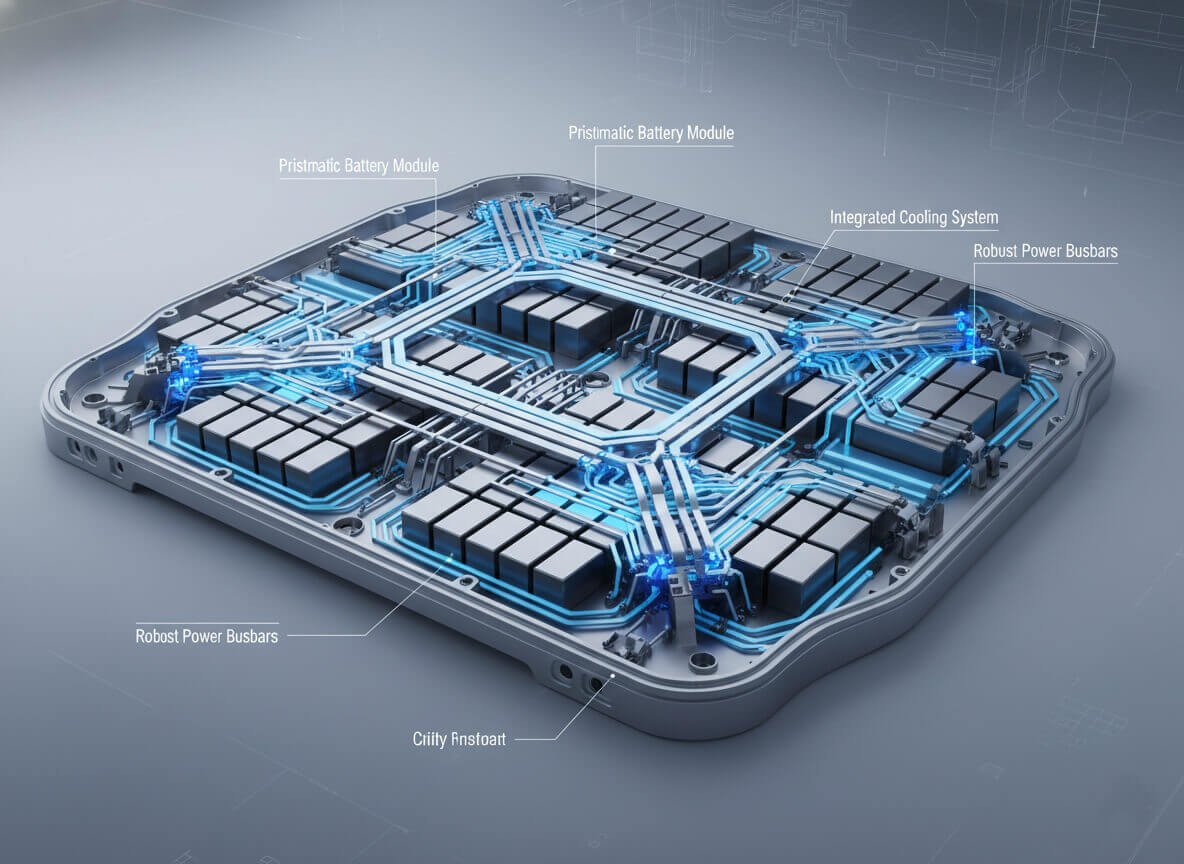
What are the Advanced Requirements for Automotive Nickel Strips?
When moving from e-bikes to full-sized electric cars (NEVs), the requirements for connection strips skyrocket. It’s no longer just about conduction; it’s about structural integrity and survival.
- Structural Support: As battery cells charge and discharge, they physically expand and contract (“breathing”). Over thousands of cycles, this movement can snap rigid connections. Automotive strips must be designed with “expansion curves” or flexible sections to absorb this 10-15% volume change without breaking.
- Safety Fuses: Modern NEV packs use strips with built-in “fuse links.” These are sections where the metal is intentionally thinned or narrowed. If a short circuit occurs and current spikes (e.g., >500A), this narrow section melts instantly, cutting the circuit and preventing the cell from exploding.
- Thermal Management: In fast-charging scenarios, heat is the enemy. Automotive strips often need to integrate with liquid cooling plates. They require high thermal conductivity (≥90W/(m·K)) to wick heat away from the cell terminals effectively.
Future Trends in Battery Connectivity
The industry isn’t standing still. New materials are pushing the boundaries:
- Nanocrystalline Nickel: By refining the grain size of the metal, engineers are creating strips with immense strength (800MPa). This allows for ultra-thin strips that are still tough enough to hold a pack together.
- Graphene Composites: Adding graphene to nickel can increase tensile strength by 30% without sacrificing conductivity.
- Intelligent Ultrasonic Welding: Moving beyond spot welding, AI-driven ultrasonic welders monitor every bond in real-time, ensuring zero defects in million-cell production runs.
Troubleshooting Common Issues
How to Fix Poor Connections and Overheating
If your battery pack is getting hot or showing voltage sag, the connections are the first suspect.
- Symptoms: The pack cuts out under load, gets hot near the terminals, or shows uneven cell voltages.
- The Fix:
- Undersized Strips: If the metal is getting hot, it’s too thin. You must add layers (“double stack”) or replace them with wider/thicker strips.
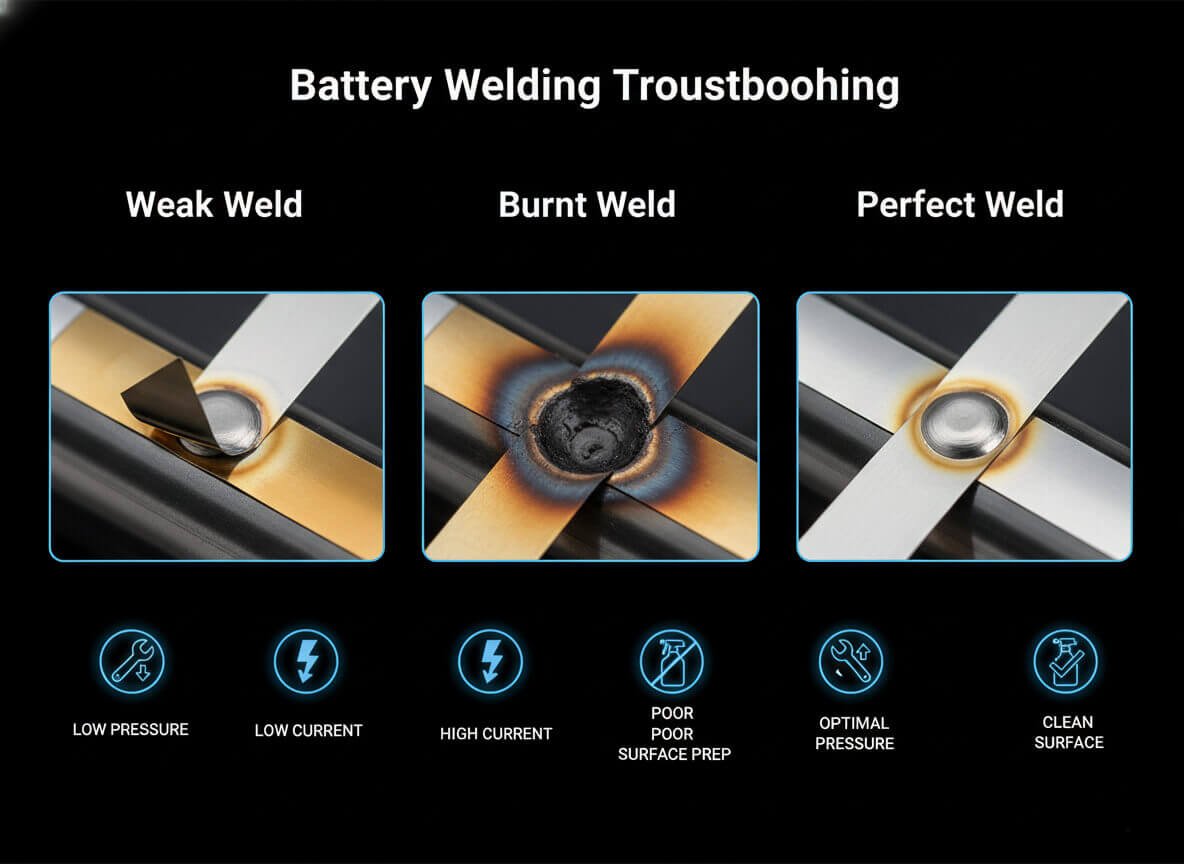
- Weak Welds: If a weld pops off easily, it’s dangerous. Increase your welder’s pulse time or pressure. A good weld should tear the metal strip before it pops off the battery.
How to Prevent Corrosion and Short Circuits
- Corrosion: Moisture kills packs. For long life, especially in automotive, use vacuum nickel plating processes that create a non-porous seal. For extreme fast-charging, silver plating is used to reduce contact resistance and oxidation.
- Short Circuits: This is the biggest safety risk.
- The “Burr” Danger: If you cut nickel strips with dull scissors, you leave a sharp edge (“burr”). If this sharp edge presses against the positive terminal of a cell, it can slice through the thin plastic wrapper and short to the negative casing.
- Solution: Always use proper cutting tools, file down sharp edges, and use adhesive insulation rings (“barley paper”) on the positive terminals of every cell.
Frequently Asked Questions (FAQ)
Pure Nickel (N6 / Ni200) is the best all-around choice. It offers the best balance of high conductivity, ease of welding, and corrosion resistance. Avoid nickel-plated steel for any high-current application like e-bikes.
Copper is far more conductive but very difficult to spot weld with standard hobbyist equipment. It requires the “sandwich method” (placing a nickel sheet on top of the copper) or a very high-power industrial welder.
Calculate your load. As a rule of thumb, a 0.15mm x 8mm pure nickel strip handles ~5-7 Amps continuously. Divide your total pack current by 5 to see how many layers or parallel connections you need. If the strip gets hot to the touch during use, it is too thin.
This is usually caused by poor contact. If there is a gap between the strip and the battery, the electricity arcs, burning a hole. Press down firmly with the probes. Alternatively, your power setting may be too high for the thickness of the strip.
It is generally discouraged. The heat required to melt solder travels inside the cell and can damage the internal seals and chemistry. Spot welding is the safe, industry-standard method because it is instantaneous and cool.
Conclusion: Building Safer, Better Battery Packs
Sizing your nickel strips correctly is not just a technical detail—it is the foundation of a safe and high-performing battery pack. By choosing Pure Nickel over plated steel, calculating your current load accurately, and employing the right series/parallel configurations, you ensure your project will last for years, not just weeks.
Remember the golden rule: “Think twice, cut once.” Whether you are building a drone battery or an electric car module, safety comes from understanding your materials.
If you are ready to start your build and need reliable, tested materials, don’t leave it to chance. We provide verified Pure Nickel strips and custom-sized solutions tailored to your exact specifications.