
Aluminum-Nickel Composite (Al-Ni Clad Strip)
The only reliable way to weld Aluminum battery terminals to Nickel busbars. Metallurgically bonded strips that solve the "dissimilar metal" welding challenge for LiFePO4 and Polymer packs.
Solving the "Aluminum-to-Nickel" Headache
The Problem: Most Prismatic (LiFePO4) and Pouch cells have Aluminum terminals. You cannot spot weld Nickel directly to Aluminum; the bond is brittle and has high resistance due to intermetallic compounds.
The Solution: Our Al-Ni Composite strip acts as the perfect bridge. You weld the Aluminum side to the cell, and the Nickel side to your BMS or busbar.
Solid-State Bonding Technology
We do not use glue or simple plating. Our Aluminum-Nickel Clad Strip is manufactured using high-pressure cold rolling and thermal diffusion annealing.
This creates a permanent atomic bond between the 1060 Aluminum base and the N6 Pure Nickel layer. The result is a single strip that behaves like two metals, offering the electrical properties of both without the risk of delamination (peeling).
Material Specifications
Peel Strength
The bond strength is critical. Our material is tested to withstand >100 N/mm² of shear stress. It can be bent 180 degrees without the layers separating.
Conductivity
By using 1060 Aluminum (62% IACS) as the base, the overall conductivity is significantly higher than pure nickel alone, reducing heat generation.
Processing
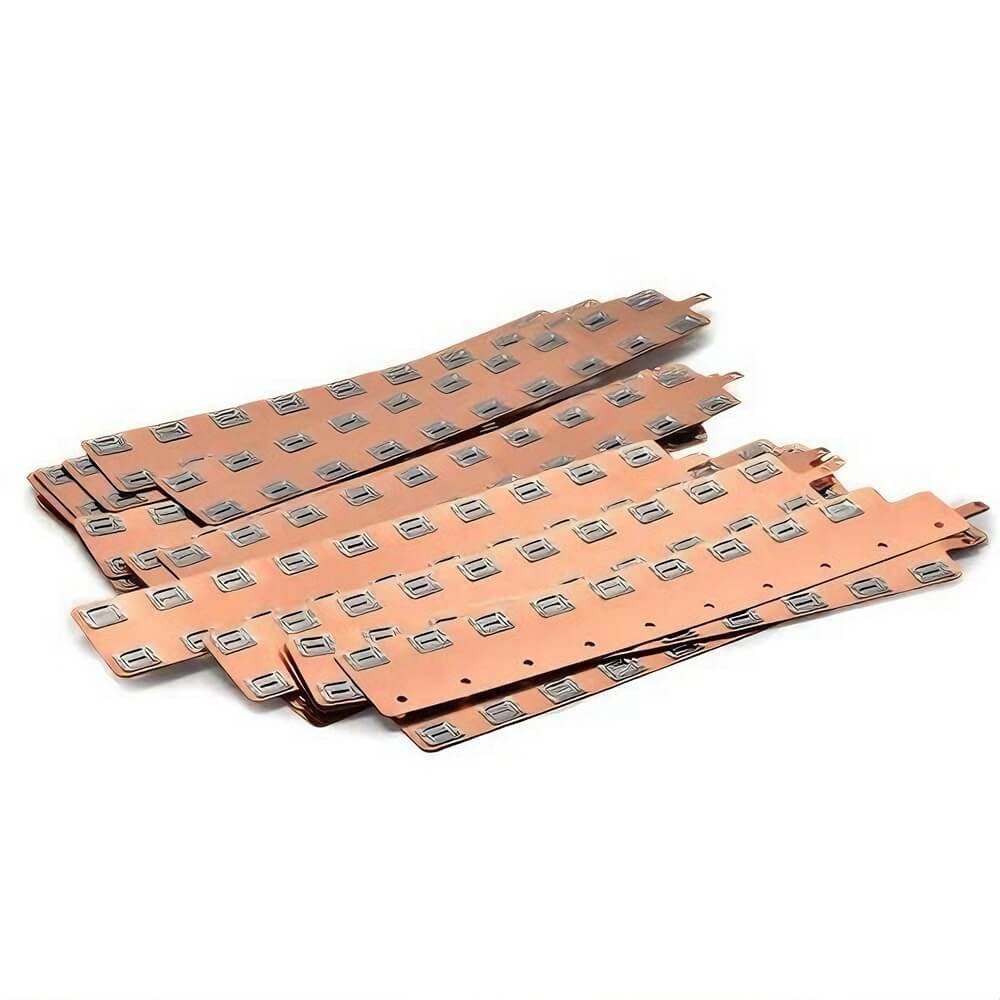
Available in master coils for automatic stamping lines, or laser-cut custom shapes. Easy to stamp, punch, and bend.
| Parameter | Standard Value | Tolerance |
|---|---|---|
| Composition | Aluminum (1060) + Nickel (N6) | N/A |
| Thickness Ratio | 1:1 or 2:1 (Al:Ni) | ±5% |
| Total Thickness | 0.1mm, 0.15mm, 0.2mm, 0.3mm | ±0.01mm |
| Standard Width | 4mm – 100mm | ±0.1mm |
| Bonding Rate | 100% (Ultrasonic Tested) | – |

Where is Al-Ni Composite Used?
This material is the "adapter" of the battery world. It is essential wherever you need to transition from an Aluminum terminal to a Nickel connection system.
Prismatic LiFePO4 Cells
Cells from CATL, EVE, and Lishen often have Aluminum positive poles. Using Al-Ni strip allows you to spot weld standard nickel busbars to these cells reliably.
Polymer Pouch Cells
Pouch cell tabs are delicate aluminum foil. Our Al-Ni tabs are ultrasonically welded to the foil, providing a robust nickel surface for soldering to the PCB/BMS.
EV Busbar Connections
In high-voltage packs, connecting aluminum busbars to copper or nickel monitoring systems requires a transition plate to prevent galvanic corrosion.
Always weld "Like to Like." If your battery terminal is Aluminum, place the Aluminum side of the strip against the battery. The Nickel side will face up, ready for you to spot weld your connecting strips or solder wires.
It depends. Welding the Al side to an Al terminal usually requires Ultrasonic Welding or high-power Laser Welding. Resistance spot welding (the standard method) is difficult for Aluminum due to its high conductivity. However, once the Al-Ni tab is attached, you can easily resistance spot weld onto the Nickel face.
Yes. We offer Laser Cutting and Stamping services for Al-Ni composite. We can produce complex tabs with holes, slots, or specific dimensions to fit your pouch cell or prismatic layout perfectly.
Galvanic corrosion can occur between dissimilar metals in humid environments. However, our solid-state bonding process eliminates the gap where moisture could enter. For extreme environments, we recommend conformal coating after assembly.
For standard rolls (e.g., 0.15mm x 8mm), the MOQ is 1kg. For custom stamped parts, we recommend 1,000+ pieces. For laser cut prototypes, we can do as few as 50 pieces.
Solve Your Welding Challenges
Our Latest News


