The Core Difference: Current Handling and Ampacity
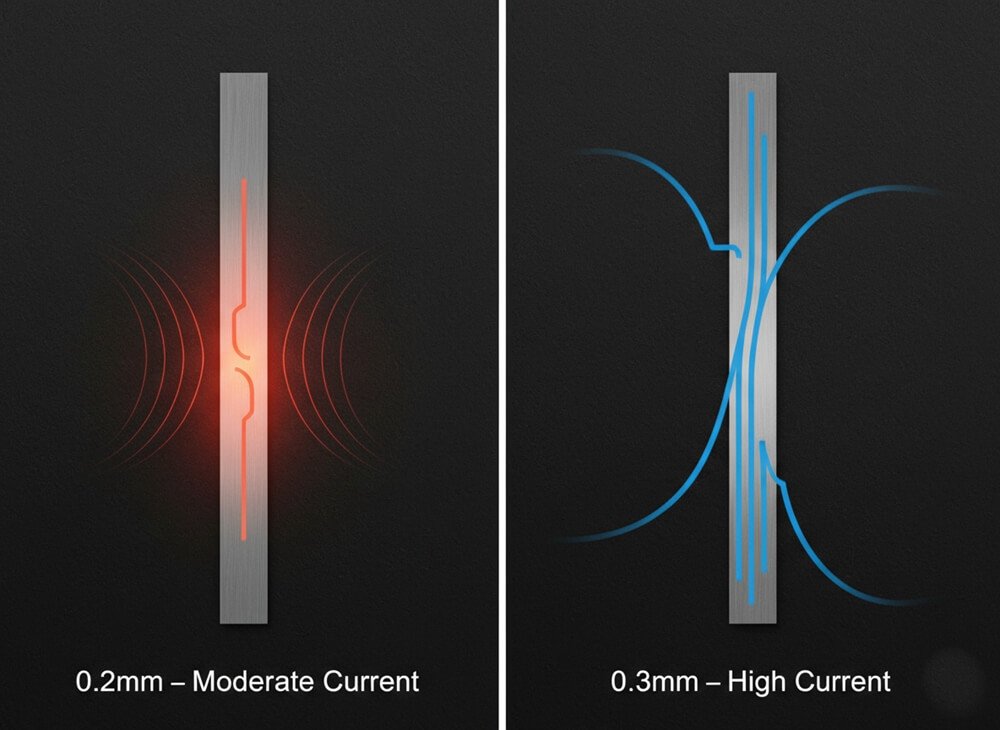
The most immediate question on any builder’s mind is simply: “How many amps can this handle?” The thickness of your nickel strip dictates its cross-sectional area. Think of this like a water pipe. A wider, thicker pipe allows more water to flow with less pressure. In electrical terms, a thicker strip allows more current to flow with less resistance.
When resistance is high, energy is converted into waste heat. This is the enemy of lithium-ion batteries. Heat degrades the chemistry inside your cells, shortening their lifespan. Therefore, jumping from 0.2mm to 0.3mm isn’t just about structural strength; it’s about keeping your battery cool.
Breaking Down the Ampacity Numbers
Different sources often cite different numbers based on how “conservative” or “aggressive” they are with heat limits. However, by analyzing data across multiple expert tests, we can establish reliable ranges.
0.2mm Nickel Strip: This is generally considered the standard for moderate-draw applications. It typically handles a continuous current range of approximately 6.4A to 10A comfortably. Some aggressive ratings suggest it can push up to 15A, but this often results in the strip becoming warm. It is the go-to choice for standard e-bike batteries (like 500W systems) where the per-cell current draw isn’t extreme.
0.3mm Nickel Strip: This is the heavy-duty option. It effectively bridges the gap between foil strips and solid busbars. It provides a significantly larger safety margin. It is designed for applications exceeding 30A pack loads or where individual series connections must handle 15A to 20A continuous current. Its lower electrical resistance means that at the same current load as a 0.2mm strip, the 0.3mm strip generates significantly less voltage drop and heat.
| Feature | 0.2mm Nickel Strip | 0.3mm Nickel Strip |
|---|---|---|
| Optimal Current Range | 10A – 30A (Pack Total) / ~7A-10A per strip | 30A+ (Pack Total) / ~15A-20A per strip |
| Electrical Resistance | Higher (More voltage sag) | Lower (Better efficiency) |
| Heat Generation | Gets warm at >10A | Remains cool at >10A |
| Primary Use Case | Standard E-bikes, Scooters, Laptops | EVs, Performance Tools, Drones |
For high-performance packs, using 0.3mm reduces the “bottleneck” effect. If you use a strip that is too thin, you are essentially choking the power delivery from your high-discharge cells, like Molicel P42As. You pay a premium for high-power cells; don’t ruin their performance with cheap, thin nickel.
The Welding Reality: Can Your Equipment Handle It?
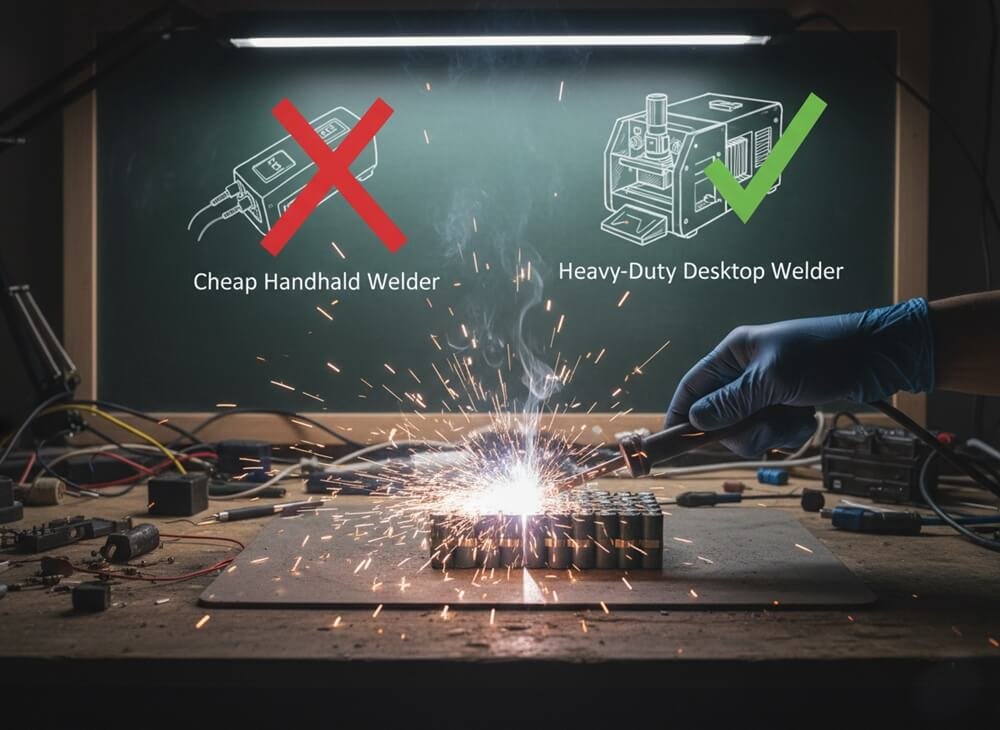
If 0.3mm is so much better for conductivity, why doesn’t everyone use it? The answer lies in the difficulty of fabrication. Welding 0.3mm nickel is significantly harder than welding 0.2mm.
Spot welding works by pushing high current through the nickel and the battery terminal. The resistance between the two metals creates heat, which melts a tiny spot and fuses them together. Because 0.3mm nickel is thicker and has lower resistance, it requires much more energy to generate enough heat to penetrate through to the battery can.
Equipment Limitations
0.2mm Strip: This is the limit for most “hobbyist” or budget-friendly spot welders found on sites like AliExpress or Amazon (often in the $50-$100 range). These machines typically deliver around 25 Joules of energy. With proper settings—usually dual pulses—you can get a reliable bond on 0.2mm material. If you are using a standard portable welder, 0.2mm is likely your maximum safe thickness.
0.3mm Strip: This requires a massive jump in power. To get a good weld that won’t pop off under vibration, you need energy levels approaching 100 Joules or more. Basic welders simply cannot deliver this current fast enough. They might make the metal hot, or create a weak “cold weld” that looks stuck but pulls off easily. To weld 0.3mm reliably, you generally need a high-end capacitor-based welder or a specific “kWeld” style system powered by a large car battery or high-discharge LiPo.
Using a weak welder on 0.3mm nickel is dangerous. A weak weld has high resistance. When you run current through the battery, that weak spot will get incredibly hot—hot enough to melt the plastic cell wrapper or even damage the O-ring seal on the battery, leading to leaks.
Durability and Structural Integrity
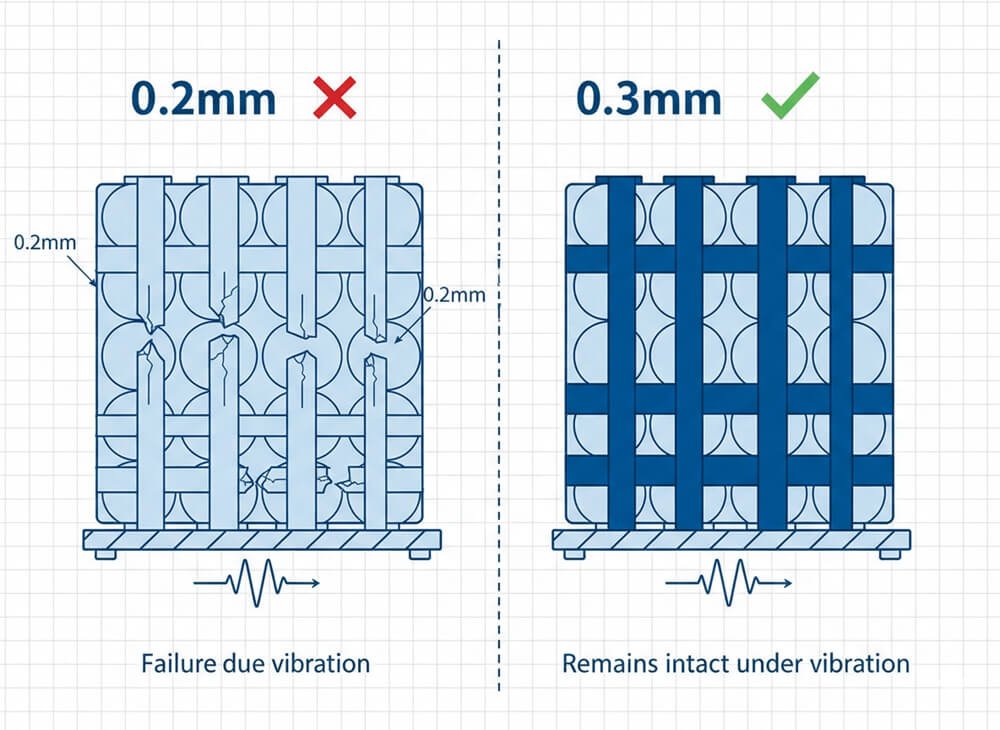
Beyond electricity, we must consider physics. Batteries in e-bikes, scooters, and drones are subjected to constant vibration and mechanical shock. The thickness of your interconnect material plays a massive role in whether your pack survives a year of riding or fails after a month.
Cycle Life and Fatigue
Real-world testing has shown stark differences in longevity. In controlled experiments comparing 0.15mm, 0.2mm, and 0.3mm strips under accelerated aging conditions (high heat, high vibration), the thinner strips fail first.
One notable case study involved a drone battery pack. Drones are harsh environments; they vibrate intensely and crash occasionally. In a drop test from 3 meters, packs built with thinner 0.15mm and 0.2mm strips experienced fractures at the weld points. The metal fatigued and snapped. The pack built with 0.3mm nickel deformed—it bent—but it did not break. The thicker metal has the structural rigidity to survive mechanical abuse.
Furthermore, during charging and discharging, cells swell and contract slightly. Over hundreds of cycles, this “breathing” puts stress on the nickel strip. Thinner strips absorb less of this stress before yielding. In cycle life tests, 0.2mm strips showed no degradation after 250 cycles, whereas thinner alternatives began to fail much earlier, showing resistance spikes.
Material Science: Pure Nickel vs. Plated Steel
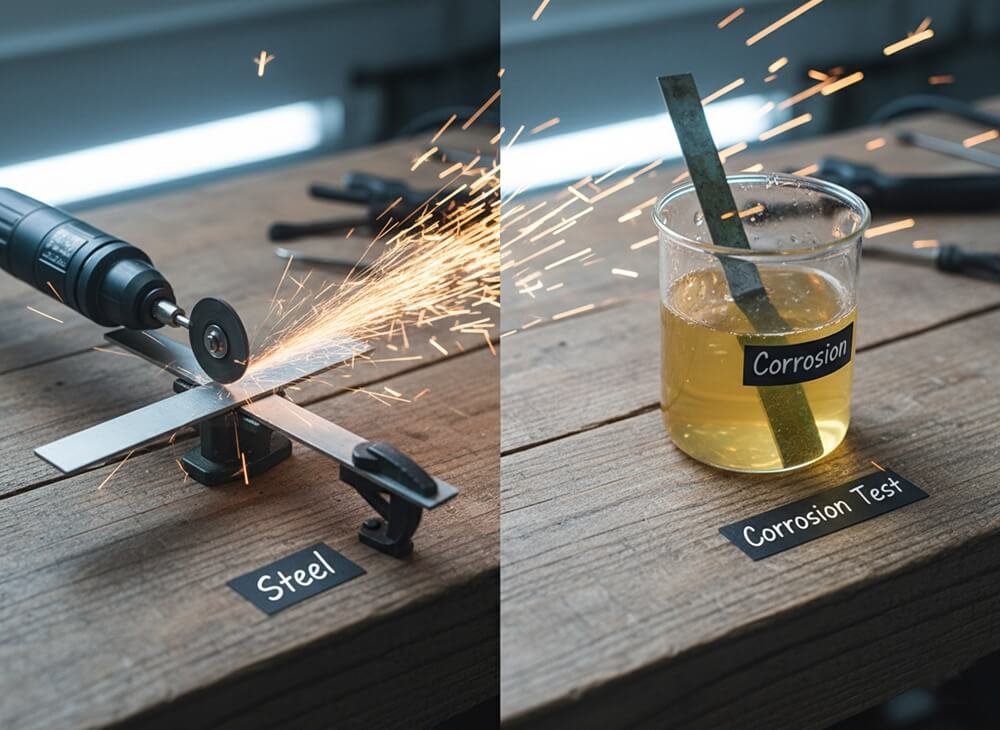
When selecting your 0.2mm or 0.3mm strip, thickness isn’t the only variable. You must ensure you are buying Pure Nickel, not Nickel-Plated Steel, especially for high-current builds.
Nickel-plated steel is cheaper and stronger mechanically, but its electrical resistance is roughly four times higher than pure nickel. If you use a 0.2mm steel strip thinking it performs like 0.2mm pure nickel, you are in for a nasty surprise. It will heat up rapidly.
However, interestingly, some expert builders prefer high-quality 0.3mm plated steel for specific applications where structural strength is more important than absolute conductivity, provided the pack design accounts for the extra resistance. Plated steel is stiffer and holds its shape better. But for 90% of DIY e-bike and EV builds, you want Pure Nickel (often designated as N6 or 99.6% pure).
How to Spot the Fake
- The Spark Test: Take a Dremel or grinding wheel to the strip. If it showers you with bright, glowing sparks, it is steel. Pure nickel produces almost no sparks.
- The Saltwater Test: Scratch the surface of the strip and leave it in a cup of saltwater for 24 hours. If it rusts, it is steel. Pure nickel is highly corrosion-resistant and will remain shiny.
Case Studies: Real-World Applications
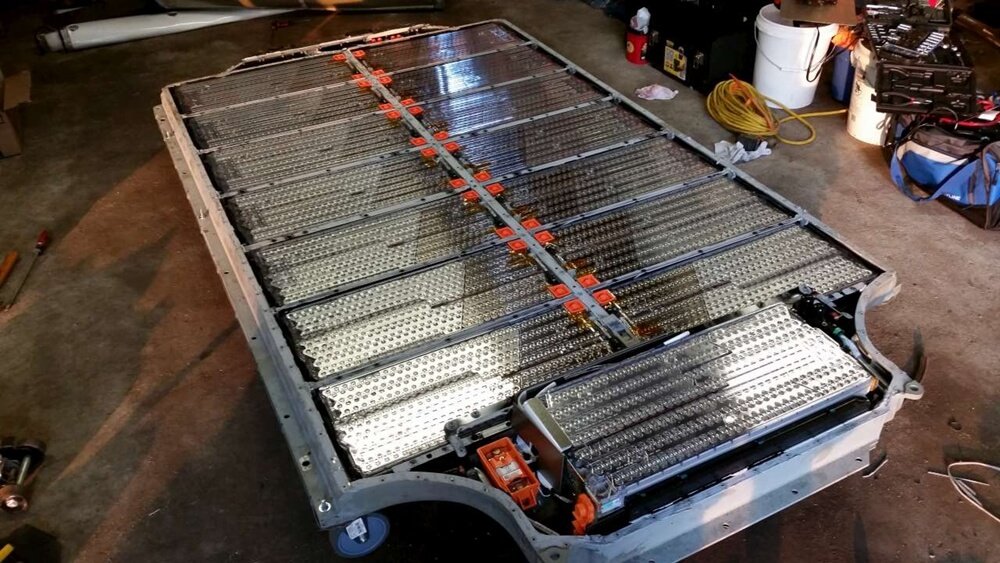
To truly understand the value of upgrading to 0.3mm, let’s look at some documented experiences from professional builders.
The Drone Weight Saver
A builder designing a propulsion system for a heavy-lift drone initially tried to use 0.5mm strips for maximum power. However, they were too stiff and retained too much heat. By switching to 0.3mm nickel, they found the “sweet spot.” It conducted nearly as well as bare wire but lay flat against the cells. Most importantly, it allowed them to replace heavy aluminum busbars, saving nearly 220 grams of weight—a critical amount for flight time.
The Golf Cart Fix
Another technician was tasked with rebuilding a battery for a golf cart—a high-torque application. The original pack used 6mm wide strips and suffered from “hot spots” near the terminals where the current bottlenecks. Instead of ripping everything out, the technician strategically used 0.3mm strips (10mm wide) overlaid on the main current paths. This dual-layer approach dropped the temperature variance across the pack from 12°C down to just 3°C. This proves that 0.3mm is essential for “trunk” lines where all the current aggregates.
The Tesla Module Repair
Even in the world of high-end EVs, 0.3mm strip has a place. When repairing corroded BMS sensing lines on Tesla Model S modules, standard copper wire or epoxy repairs often fail due to vibration or oxidation. Technicians found that 0.3mm nickel strip could be laid flush against the PCB pads and spot welded with micro-pulses. It provided a permanent, corrosion-resistant fix that survived where other methods failed.
The “Layering” Strategy: A Workaround
What if you calculate that you need the ampacity of a 0.3mm strip (say, for a 40A load), but you only have a budget spot welder that can’t penetrate it? Do you have to buy a $400 welder?
Not necessarily. Many DIY builders use the “Stacking” or “Layering” method. This involves welding a strip of 0.15mm or 0.2mm to the cell, and then welding a second strip directly on top of the first one. Mathematically, two layers of 0.15mm give you roughly the same cross-sectional area as a 0.3mm strip.
Pros:
Allows you to build high-amp packs with a cheap welder.
Cons:
It is extremely time-consuming (double the cuts, double the welds).
It introduces contact resistance between the layers if they aren’t clamped perfectly tight.
It makes the pack bulkier, which might interfere with the battery case fitment.
While layering works, a single 0.3mm sheet is always superior for thermal efficiency and structural integrity.
The Hidden Dangers: Why Thickness is a Safety-Critical Variable
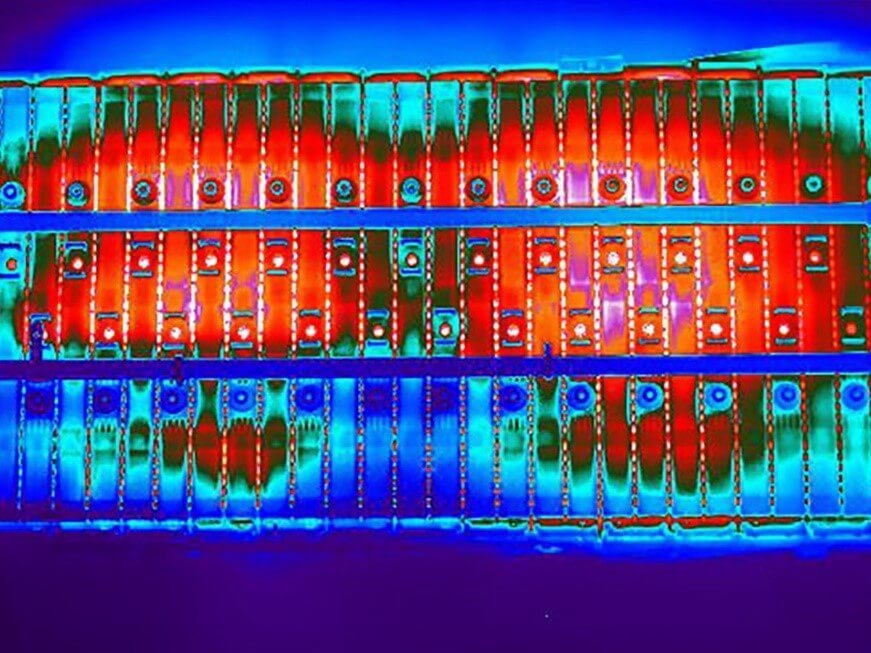
When we discuss selecting between 0.2mm and 0.3mm nickel strips, it is easy to get lost in the numbers—amps, resistance, and cost. However, the most critical factor isn’t performance; it is safety. A battery pack is essentially a box of stored chemical energy waiting to be released. If that energy is released uncontrolled due to a poor connection or an undersized strip, the consequences can be catastrophic.
The choice of nickel thickness is not just about whether your e-bike runs fast; it is about whether your battery pack remains stable or becomes a fire hazard. Based on expert safety protocols and failure analysis, here is a deep dive into the risks of getting it wrong.
The Physics of Failure: Joule Heating
The primary danger in undersized nickel strips is a phenomenon known as Joule Heating. As referenced in engineering guides, the heat generated in a strip is proportional to the square of the current ($P=I^2R$). This is a critical concept to grasp.
It means that if you double the current flowing through a strip that is too thin (like running 20A through a 0.15mm strip intended for 7A), you don’t just get twice the heat—you get four times the heat. This exponential rise in temperature is why “guessing” your strip size is so dangerous. A strip that feels slightly warm at 10A might glow red hot at 20A.
The Path to Thermal Runaway
What happens when a nickel strip gets too hot? The sequence of failure is terrifyingly predictable:
- Stage 1: Efficiency Loss. Initially, the excess heat simply wastes energy, reducing the range of your vehicle.
- Stage 2: Insulation Damage. As the strip heats up, it transfers that thermal energy directly to the battery cells it is welded to. It can also melt the PVC shrink wrap or the plastic cell holders surrounding it.
- Stage 3: Chemical Degradation. Lithium-ion cells are sensitive to heat. Sustained exposure to high temperatures accelerates the chemical degradation of the internal electrolyte, permanently ruining the cell.
- Stage 4: Thermal Runaway. In the worst-case scenario, if the strip gets hot enough to melt the cell’s internal seals or if the heat triggers an internal short, the cell enters thermal runaway. This is a self-sustaining chemical fire that cannot be easily extinguished. It can spread from cell to cell, destroying the entire pack and potentially causing a house fire.
Using a 0.3mm strip for high-current applications acts as a massive thermal buffer, preventing this chain reaction from ever starting.
Mechanical Risks: Vibration and Fatigue
Safety isn’t just about heat; it’s about structural integrity. Batteries in moving vehicles (drones, e-bikes, scooters) are subjected to constant vibration.
The “Micro-Movement” Danger: Over time, vibrations cause micro-movements between the heavy battery cells and the connecting strips. Thinner material (0.15mm or 0.2mm) lacks the structural rigidity to withstand this constant flexing. As seen in drone crash tests, thin strips can fatigue and fracture at the weld point.
The Short Circuit Risk: When a strip snaps, it doesn’t just stop the battery from working. The broken, sharp piece of conductive metal is now loose inside a tightly packed case. It can easily touch a positive terminal and a negative casing simultaneously, creating a “dead short.” This releases all the battery’s energy instantly, leading to sparks, melting metal, and fire. 0.3mm nickel strip offers the mechanical strength to resist fatigue, keeping the pack internal structure secure even under abuse.
Mandatory Safety Protocols for Assembly
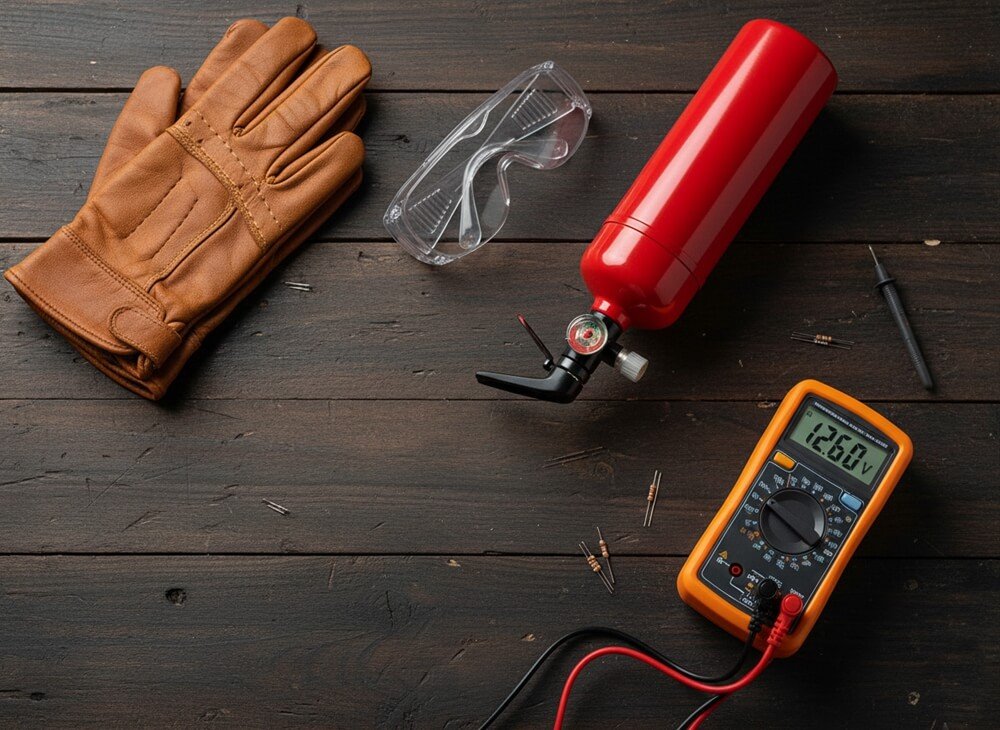
Whether you choose 0.2mm or 0.3mm, the process of welding them carries its own risks. Professional guides mandate strict adherence to safety gear and environment setups to prevent injury during fabrication.
| Safety Protocol | Why It Is Necessary |
|---|---|
| Wrap-Around Safety Goggles | Standard glasses are insufficient. Spot welding can send molten metal sparks flying sideways. These sparks can cause severe, permanent eye injury. |
| Leather Welding Gloves | Protect hands from sparks and heat. Crucially, they provide insulation. If your hand accidentally bridges two terminals, the glove prevents a shock. |
| Non-Conductive Workbench | Never build on a metal table. Use wood or a rubber mat. A metal table can short out the entire pack if the battery touches it. |
| Remove Jewelry | Rings, watches, and bracelets must be removed. If a metal watch band touches the battery terminals, it will weld itself to the battery and your wrist, causing severe burns. |
| Class D Fire Extinguisher | Water cannot put out a lithium fire. You must have a Class D (combustible metal) or at least a Class ABC extinguisher within arm’s reach. |
The “Cold Weld” Trap:
Another safety risk involves the quality of the weld itself. As noted in troubleshooting guides, if you attempt to weld 0.3mm nickel with an underpowered welder (e.g., a cheap handheld unit), you risk creating a “cold weld.”
A cold weld looks like it is attached, but the metals haven’t truly fused. Under the vibration of riding, this weak bond will pop loose. This creates an air gap where electricity tries to arc across, creating intense heat (like a mini welder) inside your finished battery pack. This is a common cause of pack failure and fires. If you cannot get a verified, strong weld on 0.3mm nickel (where the metal tears before the weld breaks), you must upgrade your welder or switch to a stacked 0.2mm configuration.
Decision Matrix: Which Thickness Do You Need?
To summarize, here is how you should decide based on your project type.
| Application | Recommended Thickness | Reasoning |
|---|---|---|
| Standard E-Bike (36V/48V, 500W) | 0.15mm – 0.2mm | Current draw is low (10-15A). 0.2mm is easy to weld and flexible. |
| High-Performance E-Bike (52V/72V, 1500W+) | 0.2mm (Stacked) or 0.3mm | Single 0.2mm strips will overheat. 0.3mm handles the surge current. |
| Power Tool Battery Rebuild | 0.3mm | Tools draw massive instantaneous current (40A-80A). Thin strips will act like fuses and melt. |
| Power Wall / Solar Storage | 0.2mm or 0.3mm | Depends on inverter size. 0.3mm is preferred for longevity and efficiency over years of service. |
| Racing Drone / ESK8 | 0.3mm | High vibration and high discharge require the rigidity and conductivity of 0.3mm. |
Conclusion
Choosing between 0.2mm and 0.3mm nickel strip is not just a matter of preference; it is an engineering decision that dictates the safety and efficiency of your battery pack. While 0.2mm is the versatile “workhorse” for standard projects and is friendly to budget equipment, it hits a hard ceiling when performance demands rise.
0.3mm nickel strip is the professional’s choice for high-drain applications. It offers superior conductivity, runs cooler, and provides structural durability that thinner strips cannot match. Yes, it demands better welding equipment, but that is a small price to pay for a battery pack that is safe, efficient, and built to last. If you are pushing boundaries with high-power cells, 0.3mm isn’t just an option—it’s a requirement.
Frequently Asked Questions
1. Can I use a cheap $50 spot welder for 0.3mm nickel strip?
Generally, no. Cheap welders typically output around 25-30 Joules, which is enough for 0.15mm or 0.2mm but insufficient for 0.3mm. Attempting this usually results in weak “cold welds” that pop off easily. You need a high-power welder (like a kWeld or capacitor-based unit) capable of 100 Joules or more.
2. How many amps can a 0.3mm nickel strip handle?
A standard 0.3mm x 8mm pure nickel strip can comfortably handle 15A to 20A continuous current per strip without overheating. In a battery pack, these strips are often used in parallel, allowing the total pack to handle 60A, 80A, or more depending on the configuration.
3. Is it better to use one 0.3mm strip or two 0.15mm strips stacked?
Physically, one 0.3mm strip is better because it is a solid conductor with no contact resistance between layers and offers better structural rigidity. However, stacking two 0.15mm strips is a valid workaround if your spot welder is not powerful enough to penetrate a single 0.3mm sheet.
4. How can I tell if my 0.3mm strip is pure nickel or plated steel?
Perform the “Saltwater Test.” Scratch the strip and leave it in saltwater for 24 hours. If it rusts, it is plated steel. Alternatively, use a grinder; steel creates a shower of bright sparks, while pure nickel creates very few, dull sparks.
5. Can I mix 0.2mm and 0.3mm strips in the same battery pack?
Yes, this is a common advanced technique. Builders often use thinner 0.2mm strips for the parallel connections (which carry low current) and use thicker 0.3mm strips (or stacked layers) for the series connections (which carry the full pack current). This saves weight and cost while ensuring safety where it matters most.